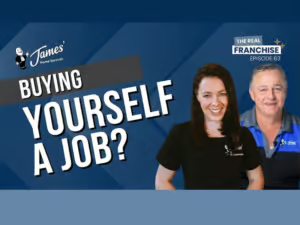

Rhiannon Hello and welcome back to another episode of The Real Franchise. This video series is designed to deliver real information, real answers, and real insights into franchising. The series is brought to you by James HomeServices Australia. I’m the CEO and Justin is one of our owners and our head of new businesses. Together in this series, we tackle all of the big topics unscripted, unplanned and unfiltered.
No sales, no fluff. We just give you information straight out. Today’s topic is one of it’s a buzzword right now. It has emerged at the forefront of socials as a total buzz concept. It is ethical sales. Now in our network, when you inquire to join our network, it’s an information process. We will always refer to it as an information process.
But if we’re being really hardcore about it, you are buying a product and a service from us. So it is a sales process that we take you through. So with that context in mind, Justin, we’re going to lead off with the biggest question. First. As always let’s dive in. Please tell us what on earth is ethical sales.
Justin Ethical sales is not just selling ice to an Eskimo. Ethical sales is, Well, you and I often talk about the laws of exchange. It’s being in in what we call the right laws of exchange. Can what I have my product genuinely help and assist this person? And if not, I’m prepared to forego that sale. Yeah, because it’s not right for them.
Right. And, this is something we have. Well, I know you’re so we’ve always, in my view, practice ethical sales, but we have got more and more diligent about that and more and more processes, which we’ll talk about in this video to ensure that if this business isn’t right or if it’s just not the right time, we will tell you that.
And in fact, I’ll be honest, I tell people that more than yes, join the team. Yeah, right. And usually it’s. Hey, look, I think you you’ll be great for the team, but just not right now. And, yeah, we’ll dive into that in this discussion as to why we say that. But ethical sales is. Yeah that classic to show, you know, hey, you can sell ice to an Eskimo will.
The Eskimo doesn’t need ice. You take it, you you’re not.
Rhiannon A.
Justin Dude. You’re robbing it. You’re not acting ethically, taking money off the poor Eskimo when he doesn’t need ice.
Rhiannon Yeah, exactly. For me, ethical sales comes down to we have a responsibility. And that is not just to sell a product because we have a product to sell and we know it. I mean, we know our product works. We back it. We know that it works. And but it comes down to a level of responsibility. It does work, but it’s not ideal for everyone because everyone comes to us with a slightly different current situation, slightly different or wildly different goals for what they’re hoping to achieve.
And in my opinion, practicing ethical sales is about making a real and genuine assessment about whether what we offer can legitimately help that person to achieve what they want. And if it can’t. So, for example, people are often coming to us to with help to start a business because they are looking for more flexibility with their time. They’re looking to get out of the daily 9 to 5 grind with an hour commute each way into the city for work.
You know they’re wanting to kick that to the curb because it eats into family time. They’re looking for, you know, flexibility in how they schedule their day. So, you know, the ability to work their work around their life. And so I really view ethical sales as us asking lots of questions. When someone first inquires to genuinely understand what their current circumstances are and what their ideal future state is.
Yeah. And if we don’t think that starting a business with us can genuinely help get them further toward that idea of future state, then it’s not the right thing for us to do to have them progress in our system and sell us to the Eskimos, so to speak. So, I want to touch on this for a minute, Justin.
It’s a buzzword right now, right? It’s coming back in. I I’m listening. I’m always listening to podcasts. I’m always interested in sort of what’s been talked about in franchising, in sales, in all of that stuff. That’s my jam, that’s my space. And that’s where, you know, that’s where my role sits. And I have a responsibility to be what’s happening in these spaces, too.
And I have really noticed in the last few months alone a massive acceleration of content creators, influencers in that sales space, beginning to talk about ethical sales. Is this a new concept? Justin?
Justin It’s not a new concept. Not at all. And speaking from our network, you know, I’ve been in this network for 15 years, and I think our network has always thought we’ve done ethical sales, but I think organizations now are getting more into the detail and ways to be. I’ll give a specific okay talk our network. When I first joined and I was involved in sales from day one in James.
It was, you know, we have a proven system. We have a great system. Anyone can join our business and if they use our system, it will work for them, right? If they use our system, it will work. And so, you know, people would buy a business up front for whatever it was back then, 30 or 40,000. And you know, in hindsight.
So we’ve gotten there since we’ve taken over ownership. And we’ve refined this a lot, particularly in the last two years. You know, we really get into the weeds, as you said, for the what they’re looking for, what they really want because I have cases. My very next phone call after this video is to is to a lovely couple.
We’ve been through this process. We’ve sat down with them and I’ve got them. We’ve done personal budgets right. And he’s got great experience and I think has great potential. So when all James would have got to start thinking, however, now that we’ve got their personal budgets and working through that, I know from his budget because he left a quit work to go to training, two weeks of training with no income, he’ll come out of training with no money to pay rent, like be out of cash.
So. Ethical sales is going, you know, in the old days it would have been. Yeah, you’ll be great. Let’s do it. Follow the system. Ethical sales. For once. I had a bit more information. And guys. Hey, I think you’ll be great, but we need to get a bit more in savings so that you know you are starting a new business.
You’ve got a family, you’ve got responsibilities, you’ve got financial commitments, and we have developed tools now so we can work out based on your living costs, exactly how much money we believe you need to have in savings to minimize at all possible the risk of running out of cash. Right. So if you have the worst possible start, income wise, we know you’ve got enough to get by X number of weeks.
Rhiannon Yep, yep. I, I’ve got a really I’ve got a really great practical example of where this kind of situation happened when I was doing your role a few weeks ago. And I, a gentleman had made an inquiry, Melbourne based, and I called him for that. You know, that first call where we just kind of introduce ourselves, have a little bit of a chat about what they’re looking for.
And I started in that first call. We really focused on asking questions to better understand what that person’s current situation is. And the reason we do it is to try and figure out if we can genuinely help, or whether this is not going to be a fit. What we’re looking for is fit, and so we are asking questions that might feel kind of odd, but it’s us trying to figure out whether this might even be a fit.
And so I was asking him these questions. You know, what’s your current working situation? And, you know, what’s your family situation? You know, you’re kind of you my age. Do you have a young family? What are your commitments there? And he started to throw off some subtle signals to me in in his answers that indicated that he might not have a full time commitment available.
So, for example, he was asking me, hey, can you do after work jobs, like after hours jobs and like, can you build a business on the weekend? And you know what? If I did like early morning work and late afternoon work? And so for us, that’s a massive signal that what he’s trying to do is figure out whether he can keep his full time job so that he’s got that stable cash flow, and he’s trying to figure out if he can build this on the side right.
And he was he was a great guy, right? He ticked all of the boxes for what we look for for an ideal candidate. He had loads of drive. Great communicator, really professional, asked very astute questions, had clearly done his research. Sounded really sound. You know exactly the type of person that we get really excited about because he’s the type of person we know this can work for.
But I just had a couple of little alarm bells going off going, hey, I’m not sure that this is actually going to work for him. So he was so keen. However, I did walk to do an information session with him right? And I thought, now normally what our information session is, is that we’ve built that understanding of the person in the first call.
So the information session is we ask a few more questions and we dive in. But then the information session is okay, spotlight’s on us now, you know. Now you ask us all the questions, you drive and you need to get from us the information you need right. But I threw that out the window. I got on the information session call with this guy, and I said, hey, I’ve really been thinking about our call for the last 36 hours since we first spoke.
I just really want to ask you some more questions, because I’m just not sure that we’re right for you. So we spent another 20 minutes talking about current situation, and I was just really direct. And I was like, hey, it kind of sounds like you’re trying to build this on the side, you know? Is there a financial reason why you can’t leave your job?
What’s your current financial position now? We kind of don’t dive into that detail until a little bit later, but I just had those warning bells. It eventuates out that he was a perfect fit, except that he really did just want to build this on the side. Now, you and I know that this is not the kind of thing you can build on the side.
It needs a full time focus. It needs a full time commitment. And it was absolutely tearing me apart because he was such a great guy. And I ended that call in a really honest note and saying, hey, look, I’ve got I’ve just got to be honest, I just don’t think that this is the right thing for you to do.
Not right now. And so we went down the path of talking about a savings plan and the kind of money that he might have to have a side first. And so some other strategies in the meantime, some other ways that he can find a second job, supplementary job that would pay after hours. Put that money aside, build your savings plan, come back to us because you’re the type of person we look for.
So I said no. I said no to our ideal candidate because it wasn’t the right time for him.
Justin Yes.
Rhiannon Right. Everything worked for us. I know that our system could work, but I know that we would put him under undue financial stress. And I know that that would impact his family. And I’m not prepared to do that. You’re not prepared to do that? We have a very strong stance on this. We’re not prepared to do that. He ended the call by saying thank you.
I’ve spoken now to four of your competitors, all of which have been ready to jump straight into whatever the next step is on onboarding me. He’s like, you’re the first one who’s been honest, he said. And I am so appreciative because I hadn’t looked at it from your perspective. I knew I was nervous for a reason, but I couldn’t put my finger on it.
And you’ve helped me to identify why I felt nervous, which is valid. And now I say I need to go away and do A, B and C before I’m ready to do this. And he was so appreciative and I was almost crying, hanging up the phone because he was so passionate. But it wasn’t the right thing to do.
That is ethical sales. And that is not a new concept to us. James has been doing it for decades, but specifically we have really gotten strict on this since you and your business partner took over this network five years ago. This for us is business as usual. It’s no buzzword for us. It’s business as usual.
Justin And I think diving into it just to show you financially another reason why we do it right in other business models, other franchises, it’s pay upfront. Yeah. And so the temptation from a sales perspective is because we have this all the time. People, have the money to pay upfront and oh, well, it’s a big chunk of money that we can make.
Yeah, we’ve made our money. All the best. I hope you do well in our network. And inside, the salesperson might be thinking, oh, well, I don’t know how they’re going to go. Right. That’s unethical sales in my view. Yeah. Our whole business model under the subscription. So we don’t make money from selling a franchise for a long time.
You know, I think it’s a year plus before we’re in front. So it’s not we’re after a long term success. You know we have a fee structure that’s a percentage. We talk about it in other videos. So we’re only going to make money if this person is successful. Yeah. So what I love about our business model and the subscription model, it supports ethical sales in that, you know, as a sales person myself.
Yeah. The temptation can be what we call in sales terms the next chicken dinner. Right. They talk about sales that are just focused on the sale itself. You’re chasing the next chicken dinner. That’s not ours at all.
Rhiannon It doesn’t work. Not nice.
Justin If we spent someone give us $1,000 on our subscription. What a cluster. So I think roughly 15 K to set people up, train them all the rest of it. Be. And then they start where? Behind the eight ball 14 grand. If it doesn’t work, it’s not.
Rhiannon That’s enough. Yeah. That’s right. And so you know in most networks where it’s a pay upfront model, they get they get that hit upfront. And so there’s no I mean now I don’t I don’t want to be. This is not about trying to say that every other network out there is is acting unethically. That’s not what this is about.
It’s just to try and point out that our model specifically, it really doesn’t reward us for making a poor decision, right? Yes. We only get rewarded long term and we only get rewarded when we make a good decision. That’s great for both parties, not just us, but genuinely for the business owner as well. And when you pair that great decision with our support actually helps them to build a successful business.
Those two things have to be present for at least 12 to 18 months before we actually start to recoup what it is that we spent just on that initial outlay. And so, frankly, if you’re of a business mind, you’re probably listening to this going, you guys are absolutely not focused on how are you profitable and sustainable? Well, because we’re getting it right, because we’re making good decisions.
We’re getting the right kind of people who really fit with our ethos. And then our support is second to none. And we back those franchise business owners in our network, and we help them grow successful businesses fast. And that’s how we are sustainable, because what we’re doing genuinely works. We’re not sustainable because we get that heat upfront, and then whatever happens later happens and that’s on the business.
Sign up. That’s not how our model works. We are very much set up that the model is us walking the walk, talking the talk, putting our money very literally where our mouth is and backing our system to do the right thing by the business owner. And that to me is the epitome of ethical sales. When your whole model only rewards an ethical sale.
So me, that’s walking the walk and I really, really am proud that that’s how we operate in this industry because there’s so much criticism. It’s really easy for a lot of people to criticize franchising. You know, there’s several industries that just, you know, they’re the butt of a lot of criticism, and we’re one of them. And I’ve become very used to that.
So it’s really not to be to be able to, you know, you hear that criticism on a daily basis and it’s impossible not to, you know, hear it and take it on board. But then I remind myself how we actually have set this network up. And I remind myself that we can’t operate if we’re not doing this ethically.
Justin Yeah.
Rhiannon So I want to talk just for a little bit. I want to switch gears because we’ve talked very, kind of philosophical there for a minute. I want to switch gears and talk really practical. Right. So how how do we practice ethical sales? We’ve talked already about we ask a lot of questions. So we genuinely understand what someone’s goals are.
And then we are only prepared to continue in the process with them. If we actually think that what we do in helping people start businesses can help them achieve those goals, then there’s a whole nother layer of detail to this. Now, you touched on it earlier, I want to go back to it and talk about it in more detail.
We have a break even point that we calculate, and we have a cash position tool that we use to guide our decision making on financial sustainability of the incoming business owner. Can you talk us through what both of those are and how you use them to guide your decision making?
Justin Yeah, so we get a fair way down the process before we do this so that the individual is confident this is what they want to do. Right? Because sometimes I find people are very hesitant to, you know, after a first phone call to give me their personal family budget and their assets and liabilities, like, whoa, not going there yet.
I want to have more time. So we take them through that process. Like, you know, if you inquire, you’re going to get to meet other business owners. You get people’s phone numbers, you can ring anyone. We did a lot of zoom meetings. So you can talk face to face so that you can do your research. So that’s paramount.
That’s why we do that. Then when you come back to me and go, hey, just that would love to join the team. We send you an application that helps us work through these criteria. You know, we’ve talked about before, we’ve got to get a claim. Please check to know that, you know, those sort of things where and they are the two there’s two attachments.
One is on assets and liabilities. So to get the assets and liabilities individual must be linked in a personal budget. And then what we do is when that comes back to me, we feed it into this cash tool which is a cut. We’ve got this much in resources. This is what it cost you to live each week. If you join us, this is going to be a weekly subscription fee.
So that’s an extra cost on the budget and a weekly subscription fee so that, you know, then you’re going to need this much each week and expenses to stay afloat, to keep the family, the roof over your head, everything operating. You’ve got this behind you and you’ve got this ongoing income. You know, this might still be in the job, or they might be getting, various government payments or income from other sources.
So you’ve got this much income coming in. So that means even if you don’t get a single job, how many weeks can you survive? And that’s what we look at. How many weeks can you survive? You know, yes, we have an income guarantee that kicks in in week three of operating and business and all of that. But let’s for the sake of this exercise, let’s forget about that.
Let’s just have a look at how long can you survive with zero income.
Rhiannon Yeah. It’s about generating what we call your break even, which is basically, you know, your other household income that will continue from a spouse or pets, you know, government family payments, those sorts of things. Income that will continue minus what it costs you to live every week. And then we get this number and it’s, you know, what, money each week.
In addition to that continuing income, are you going to need this business to generate in order to cover your life expenses basically. And and so, you know, our benchmark is kind of a little bit different. We take we we kind of have no one set number for what, you know, we need in terms of a week’s survival. We have kind of a range and we take it on a case by case basis.
If you’re someone who has a very small breakeven, i.e. you only need a few hundred extra dollars per week and you’re covering all your expenses, then we would feel more comfortable because we know that in a few weeks we can get you there pretty easily. If you’re following a system, right? If your breakeven is a lot higher, then we’re looking for a little bit more survival because we know that it’s going to take us a little bit longer to get you there.
So it’s a range, right? We don’t have one definitive answer. And the reason we also don’t have one definitive answer is that everybody’s circumstances are different. And the whole thing about ethical sales is that you’re looking at everybody through a lens of their own systems, stances, not one set of rules. So we have guidelines. We have 30 years of experience of doing this, but we also it’s important to us that we take every single person on a case by case basis, and we genuinely work with them to better understand their position before we make a decision.
But if, in our opinion, it’s a bit too skinny, you don’t have many wakes up your sleeve, then we will defer you. So we will say it’s a no, but it’s not a no. Forever. It’s a no for now. And then what we do is we start talking about a savings plan and we say, if you’re really serious about this, then this is just a no for now.
And let’s talk about a pathway that gets you to the kind of, you know, money that you need to have set aside in savings, where we would feel comfortable that this is now the right decision and the right time for both parties. So, Justin, you you literally will sit down with people and work out a savings plan, don’t you?
Justin Yeah, absolutely. And then I catch up every month just as to see how they go in with it and help them keep on track and that sort of thing. Yeah. Now we’ve spoken a lot about finance as one of the areas. You know, there’s a couple other key areas that I see come up a lot where, we have a lot of people across this country.
Keen as must mustard to join us. Great people, but communication skills, English skills. Yeah. Not really the you know, I like, recently come to this country, and I, you know, I starting a new life. And the challenge with our business is it’s people serving people. So, you know, it’s you’ve got to have a high level of communication ability in English because, you know, you’re going to get the leads are going to come directly to you.
If you’re the business owner, you have to call that customer. You have to make it time to go see that customer to do a quote. You got to do the quote, find out exactly what the customer wants. You know, all of that has to happen and has to happen in English. And so one of the tough ones is having to say to people who are so keen, look me, that we had one, as you know, just recently that was so keen to start.
And we just had to say, look, I just don’t think it’s going to work for you just yet. You know, work on those skills. Well, communication it because that individual it was fine on the finance side, it was ticked all those boxes and and maybe in other networks we’ll get a start. But I can’t see it working for them.
And so that’s a tough decision for us because we’re saying goodbye to that opportunity, hopefully not forever, but it’s the right thing to do because they won’t succeed in a business like this.
Rhiannon And that’s not just us, you know. You know, got going. It’s not right. We don’t think it’s going to work. That’s us basing this decision on our experience, which is that when we have started, people with, you know, and we have, frankly, such a high proportion of our network is English as a second language. And I take my hat off to anyone who can start a business in their second, third or fourth language.
And we have so many people who do it and do it successfully. But what we have learned is that when English is your second or other language, but you’re you’re still actively learning the language, it can be really, really challenging for you to pick up some of those nuances when you’re communicating with people, particularly in a negotiation, to lock in a job situation.
That’s where we find that people struggle the most. Yes. And if you can’t lock in those jobs, then you can’t make an income. And so you know, our our guidance to people around this, you know, needing a high level of communication skill is very much based on our experience. Is that where we’d have seen people really struggle in the past in our network is in that like objection handling communication negotiations face when they’re working face to face with a client trying to lock in a job.
Now, I just want to also say we’ve been talking about this is English as a second language. This equally applies where English is the first language. We at least we absolutely have situations where even when English is the natural language, the communication skills are just not quite there. From a hey, you’re going to have to rely on these skills in your business to make money.
And so it doesn’t matter what your background is, what your story is, what your color is, it’s communication skills that we’re looking at, not who you are or where you’ve come from. You know, I just want to pop that in there and make sure that it’s it’s very much it’s skill. It’s a skill based decision on our part.
And we’ll be very honest with you, it’s not a flat no. Again, like the finance thing, it’s a hey, if we’re honest, we feel really nervous for you because of X. But hey, there are lots of ways that you can build your skills in those areas and we help them with like courses or wet places they can go and, you know, additional things they can do to build those skills.
And then we are an open door or what you come back, touch base with us, check in with us. You know, if you really want this, go do that work and then come back to us. Ready to go.
Justin Yeah, absolutely. And this like, there’s so many. I just want people to understand it’s not just finance or this whole ethical sales. It’s. Yeah. You know, there’s so many different things that we look at through this process. And we literally have a form that I fill in that we go through and make sure that, you know, another area is if people, you know, not I won’t use a computer.
Yeah. And it’s like, well, we’re maybe not the right network because we’re actually paperless. Everything is done on a computer. Everything comes through on computer, you know? So you don’t have to be a computer geek. Oh, I’m terrible on computers, but you need to know how to turn one round and navigate around a computer because you’re going to your business is going to be operating.
Rhiannon Yes. I think for us, ethical sales is just being about really honest in the areas that we say people struggle in their businesses, in our network and just and just like kind of bringing that to the forefront with potential inquiries and saying, hey, just so you know, you know, we’ve spent several weeks now getting to know you, and vice versa.
And, you know, our observation is that, you know, these are the areas that you might struggle in our network, and this is forming part of our decision, you know, how do you feel about that? And so often it also comes down to attitude. You know, we did have somebody, about 18 months ago in Victoria who came to us with very little computer skills.
Right. And you said to him, you said, hey, I just need to be really honest. Like we run based on a computer. And if you, you know, I need you to demonstrate to us that you’ve got a willingness to actually learn and use a computer to run your business. And this guy, totally, to his credit, was like, Justin challenge accepted, and he went away.
He learned computers. He can operate an email address where he couldn’t. He can navigate around a computer where he couldn’t before he downloaded a typing app and taught himself how to type and it was a beautiful turnaround to watch because also, I will say this guy was a little older and it was so nice because he was like, no, I’m going to I’m going to figure this out.
I’m going to learn this. I want a business. And if that means that I’ve got a bridge, this skill gap, I’m going to do it because that’s what I want. And he done well. He went away and he put the effort in. And now he’s running a business in our network and he’s using the computer system he’s got lots of help with from his wife and his son, which is also a great thing.
You know, we also take that into consideration. Do you have support in your immediate family, in your immediate network? Because if you’ve got support, then you’ve got support from them. You’ve got support from us and between the two sides we can teach you what you need to know. So there’s you’re right. There’s so many things that we think about and it’s also nine times out of ten it comes down to someone’s attitude.
And if their attitude is okay, if that’s what I need to do to get where I want to get to, I’m willing. As long as you guys show me the way, I’m willing. We are always looking for attitude. And if your attitude is willingness, one of willingness want to give it a go? One of I’m going to put my head down and I’m going to work at this because this is what I want.
I’m committed to this. You’re our person. You’re our type of people. That’s what we’re looking for.
Justin We have so many starters and I would say, yeah, so many studies in our network who it’s been 6 to 12, even 18 months at times from their first conversation with me until they’ve started. Yeah. Because there’s, you know, things like that. We’ve got a great guy starting in Newcastle shortly and end of August. I was just looking yesterday.
We first spoke, first week of January, you know, and because of a couple of things he needed to get in place, we’ve, you know, and it’s just and that’s ethical sales. If we had started this individual earlier, it would have been extremely difficult. Yeah. And might not have been successful. But now we’ve got all that stuff in place ready and raring to go and,
Yeah, I’m sure he’ll do great.
Rhiannon Yeah. All right. Well, we’ve talked about a lot of things. I think that’s a great place to wrap this video. We’ve talked about ethical sales being business as usual for us. We’ve talked about it being a real balance of making sure that we’re finding people that are the right fit for our network who genuinely, based on our experience.
So going to have a really good chance at being successful in our network had the right attitude, whose goals and what they want to achieve through business ownership match what we’ve seen people do in our network, and also making sure that that financial piece of the puzzle stacks up and that we’re really only saying yes if it’s financially responsible for us to do so, as well as all of those other things.
So it’s a great place to leave this video. We’ve covered an awful lot of ground. I hope that you’ve hung in there if you’re listening, and I and I really hope that it’s just a hope that if you’re listening because you’re thinking about this, that it’s kind of giving you an opportunity to take a deep breath and go, oh, okay, these guys are not just about making a sale.
These guys are genuinely going to work with me to make sure this is a good choice for both parties, because that really, in a nutshell, is what this is about. Yeah. So let’s leave it there. I hope that you can join us again very soon for the next episode of The Real franchise.
More Information on subscribing to your own business
Want to speak to a real person about joining our network? Get in touch directly with our National Director of Sales; Justin Kelly on 0438 780 363
Want us to contact you? Submit an enquiry