
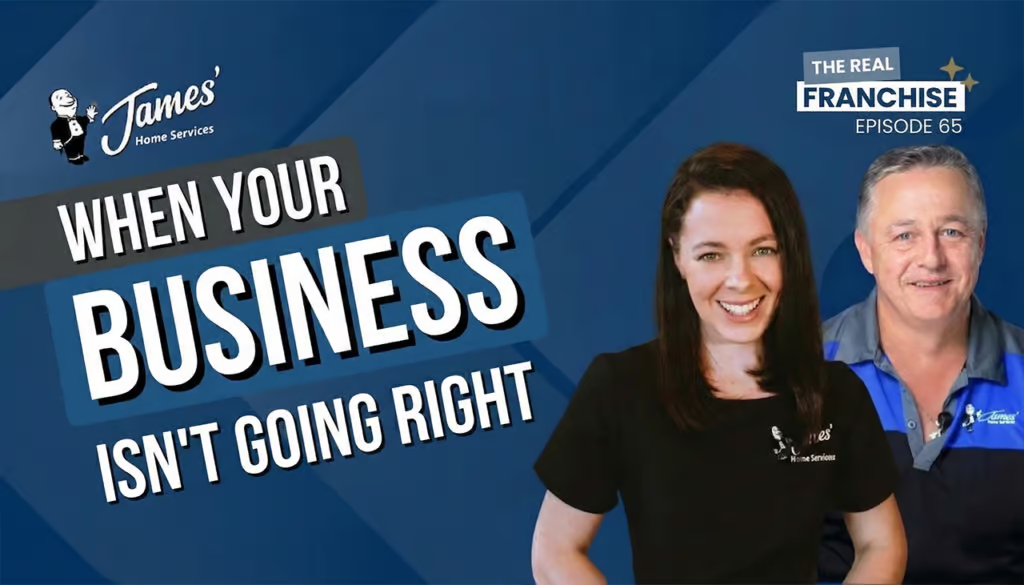
Rhiannon Hello, and welcome back to another episode of The Real Franchise, a podcast that goes where others simply won’t an unfiltered view of franchising, business mindset, and everything that we stand for when it comes to supporting a community of small business owners. Join me, Rhiannon the CEO for James Home Services, and Justin, one of our owners, as we unpack it all with no topics off limits.
And today I’m throwing straight to you, Justin, to introduce the topic that we’re going to talk about today.
Justin Yes, I had an interesting question thrown at me, and I would love to see as our CEO, how you would answer it, the question, was a good one. It was quite simply, so what do you do when your business is not going the way you want it to go?
Rhiannon And big question. There’s a there’s a lot of different, avenues to go down on this one. And I think I think we keep the answer logical and progressive. The first step is actually simply acknowledging that you have an issue and. Social media is a wonderful place that shares lots of business information. But if you’re building a business based on the advice and guidance from social media, then you’re probably being told that if you notice your business struggling, you know you’ve just got to fix one thing or there’s just there’s this magic cure for something and it’s this, you know, and so there’s so much noise that business owners are hearing these days.
And so. You have to first acknowledge that you actually have an issue. Now this is actually the hardest part for most first time small business owners because sometimes in a small business it’s harder to spot the problems than when you have problems in a big business. When you have problems in a big business, they’re really obvious. If you’re running out of cash, it’s really obvious.
If you’re not generating leads super obvious if your sales team aren’t converting. Very obvious right? If you’re in a larger business, problems can be easier to spot. What I experience, in our networking. Also, in my previous roles as business consultant, I’ve worked with all sized businesses, I’ve run businesses, I’ve started businesses, I’ve consulted to businesses, small, medium, large, all sorts of industries, international, national, everything.
And in my experience. Particularly when you’re a small business, the biggest and the first sign that you’re in trouble is that you’re using revenue from today’s sales to pay yesterday’s bills. So, for example, you know, you make a you make a sale today and instead of using that for tomorrow stock in tomorrow’s bills, you going oh my God.
Thank goodness. Now I can pay the lease on my warehouse or you’re using your personal your personal cash to pay for, you know, Meta ads or you’re using your credit card as a cashflow buffer? Or, you know that you’ve got three bills that are due at the end of this week, and you’re watching your bank account like a hawk, and you feel sick because there’s not enough money in that bank account to pay those bills.
By the time that you and you’re just hoping, you know, the fingers crossed method is your business strategy for bill payment, you’re just hoping that enough invoices are going to be paid in the next 48 hours, that you can pay those bills. And a little bit of this is okay when you’re a brand new business and when it’s planned, when it’s expected, and when you can catch yourself up fully, very quickly.
But the problem arises more so when the time gap between when you receive an invoice that needs paying and when you actually pay, it starts creeping out an ad in. And now that is your first sign that your business is struggling. And the first thing you need to do when you spot something like that happening is you need to acknowledge it.
You cannot sit back and say, oh, it’s the economy or the RBA just raised interest rates for a second time in a row. It’s that, you know, I mean, you and I have had all of the rationalizations that exist in this world for why businesses fail. And frankly, that’s all they are. They’re excuses. A business fails when you fundamentally don’t have your product or service, right?
And you don’t have your marketing, right, and you’re not generating leads and you’re not making sales. So acknowledgment is the first step.
Justin Yeah. And I think the challenge often so many of us in a small business is that when we’re in that situation, oh, I’ve just got to work harder. You know, I’ve just got to put in more hours. You know, it’s a small business and and, you know, this is normal. And, and the problem is if there’s a problem and you don’t acknowledge it, you can work harder and harder, harder to achieve it.
Yeah. The problem still there, Right. Yeah. It’s just going to be magnified.
Rhiannon I think indeed that’s another dead giveaway if you’re working harder and harder and harder in your business, but you’re not actually seeing more profit being generated, that’s a that’s a darn good sign. You just become an employee in your own business, because your job when you own a business is not necessarily to be the person doing absolutely everything.
Your job is growth. Your job is business development. Your growth is leadership. Your job is leadership and strategy. Risk management, financial management. If you’re on the tools every single day of the week, banging your head against a wall, taking on more and more and more. And if you’re taking back operational tasks that your team should be doing, that’s another dead giveaway that you’re headed for some big challenges ahead.
Justin Yeah.
Rhiannon Yeah, I think, I think once you identify, once you acknowledge that there’s a problem, the next logical step is you need to identify exactly what that problem is. And I’m going to go back to social media again for a moment because I spend a fair bit of time on social media. It’s a really helpful medium, but it can also be equally destructive.
And just in the last few weeks, a lot of content has been, served to me, where creators are telling small business owners this is like business owners, self-help content and creators are telling small business owners, just fix this one thing. You just need to fix your marketing and you just need to fix your sales. That’s all sales cures all, marketing cures all.
As long as you get that sorted, you know you’ll be fine. You know, as if whatever issue you’re having in your business will be solved by either marketing or sales, and they’ll know they’re not wrong most of the time. One of those things is a contributor, but if you’re generating leads, that means your marketing is working. If you’re making sales, your converting, then your sales process is working.
If you’re actually doing those things, but you’re still experiencing struggle in your business, doing more of these things is just going to compound the issue because the issue is structural.
Justin Yes.
Rhiannon And where in my experience, where a lot of businesses actually fail is we all talk about growth pains, right? You’ve probably heard about it. I’ve talked about it quite a lot with our company. You know, sometimes, sometimes I sometimes you probably feel like I’m pumping the brakes on growth. Right. And the reason is because it’s kind of naive just to think that if everything’s going along okay, then it’s right to increase marketing and sales.
You really have to have your ducks in a row. You have to have your ops down, you have to have your HR down. You have to have your systems down. You have to be healthy. From a financial standpoint, all of those things play a role. And if you don’t have everything else in place and working, then just adding more marketing and more sales is only going to add more chaos to the situation.
Justin You know? Very true. Yeah. I think if there’s a problem and you scale and grow, the problem grows as well. Yeah, it’s just natural, isn’t it?
Rhiannon It is, it is. And and when when we talk about growing pains, you know, you trying to scale a business, you try to take it from a small business to a medium business or you’re trying to scale a medium enterprise into a large enterprise. When we talk about growing pains, it’s not always sales and marketing. Often it’s these other structural things, and you’ve got to actually figure out exactly where the problem is coming from before you do anything else.
And so if you’re listening to this and you’ve got a business or you’re thinking about starting a business or thinking about joining a franchise network to start a business, if anybody gives you the advice or if you’re struggling at sales and marketing, don’t.
Justin Yeah.
Rhiannon They’re not really super knowledgeable. They’re not looking at the full picture. So how do you identify where the issue is? While this is complex right. This is why business consultants exist. Because, structural issues in medium and large scale businesses can be very complex to identify. And you’ve got to look at things like, you know, you’ve got to start with, pricing.
You’ve got to start with looking at your margins. You’ve got to look at your cash flow. You got to examine your expenses. By the way, if you’re scared to look at your financial information, that’s your problem right there. You know, full stop. If you are fearful of opening your management accounts in your accounting software because you don’t know the story that they’re telling you about your business, that’s your problem.
Justin You know?
Rhiannon Yeah, go and find someone to help you learn how to read a P&L. You know, because your finances tell you the story of your business.
Justin And I think for so many small businesses, it really falls into two categories. Like most small business owners have the technical expertise. You know, they might have been a brilliant mechanic, so they’ve opened up a mechanic shop or you know, that translates to all sorts of industries. So from a technical side, I think most business owners will have that gut feeling, know roughly where the issue is.
Right. So you’re probably if you’re a business owner listening, you’ll probably have a rough idea. But don’t just rely on only that because, yeah, on the other side of the scales is this big thing I think you’re talking about is, oh, I say, we don’t know what we don’t know.
Rhiannon Yeah.
Justin And, you know, I know you’ve just been working with a situation where, you know, someone’s got a lot of technical expertise, but on the other side, you know, might not be so receptive or knowledgeable. And that’s the challenge that’s in their business. Yeah. You know, and it’s and it’s being prepared to be teachable I guess to, to to find someone who can help to have an answer who’s outside of the forest, they can have a look in and go, well, actually, here’s a couple of really things that aren’t right.
Yeah. Not being prepared to make that step. Be humble enough to to get a hand. Yeah.
Rhiannon You you’ve also just got to be really honest with yourself. Like when you’re trying to identify where the issue is in your business, you have to ask yourself a series of questions and then be very prepared to answer them honestly. You know, the first question is, does the market genuinely want what I’m selling? Is there real demand? Now?
I don’t mean that. In your opinion, would you buy from yourself? I don’t mean would your mum buy from you or your best friend. I mean, are they real? Are there real customers out there prepared to part with cash to do business with you? If there isn’t, you’ve got a fundamental problem in that you can’t sell something that the market doesn’t want.
Selling ice to the Eskimos is a term thrown around in, you know, as a joke all of the time. But if you are trying to sell ice to the Eskimos, it’s very, very difficult. They don’t need it. They don’t want it. No matter how good your price is, no matter how good your pitch is, no matter how great your marketing is, they don’t want it.
If the market doesn’t want what you’re selling well, you need to go back to the drawing board and revisit what you product or services. The second the second question, which I would encourage you to spend more time, is if you answered yes to the first, there’s demand for your product to service, then we’re here, we’ve got demand. This over here is the finish line or the completed sale.
If there is demand but you’re not making sales in your business, there is something in here preventing the person with demand from walking through your process and buying from your business. Now, this could be it could be pricing. It could be customer experience. It could be that your website’s rubbish. It could be that there wasn’t enough information online so that they built enough trust.
It could be that that you weren’t findable online. It could be, it could be a million things, frankly. And it could be as simple as your website’s okay, but they got to the end and they put all the things they wanted in the cart. But you didn’t offer them 10% on their first purchase, and so they abandoned cart, or you didn’t have the right payment method for them.
So they abandoned cart in our businesses often. What’s going on in here comes down to responsiveness and customer service. So where where in the service industry is probably everybody listening is aware. We operate cleaning and lawn and garden care businesses. And so, you know, some of the common things that we see going wrong in here, someone’s not buying it.
People aren’t getting back to their inquiries fast enough. They’re not skilled enough on the phone at educating the person as to why we do a face to face appointment, why we quote, buy the task and not buy an hourly. Right. The customer experience just isn’t where it needs to be. There’s not enough trust built.
There’s not enough rapport built. The person, operating the business asks questions, but then talks over the top with somebody. It could be any number of things that are going on in there. So it could be cost. It could be your margins, but it also could be something as simple as responsiveness and the customer experience that you’re delivering.
Justin Yeah. And I think visually if people want to understand what we’re saying here to me, the hospitality industry, if you go to any esplanade, I’m going out with friends tonight to the Esplanade on the Gold Coast for dinner. You can stand on the asphalt and look up left and right, all these different restaurants as restaurants, places to eat.
Some of them will just be packed and humming. And right next door they’d be dead. Did not there be no one in there? And you? Can you go to any place like that in the country and you’ll see like this demand they are in the same industry, doing the same sort of business. But why is someone obviously and the other and it’s these sort of things I think we’re talking about that translate into other businesses.
There’s something going on there that they haven’t got right. And until I sit down and go, okay, we need to change. I had this great idea. I thought an Ethiopian restaurant in this place would really hit it off. It hasn’t. What have I got to do to to make this work?
Rhiannon Yeah. And this is the part where you’ve got to be brutally honest with yourself. You, you know, if you go easy on yourself and you make excuses, you know, the, you know, people, people just go to the one next door because it play’s louder music or people just go to the one next door because their prices are $5 cheaper a meal.
Or if you sit there and you make excuses and rationalize why it is that they’re there and they’re not in your restaurant or their their competitor’s business and not at yours, you’re never going to see growth in your business. Because guess what? Now you’ve become the problem. You’ve become the structural issue. You can’t out market your own mindset.
You can’t out sell your own mindset. Businesses that are successful in my experience, have business owners that are prepared to listen to market feedback, no matter how brutal it is. And indeed, I mean, that’s what we did, right? We did that in our model. The reason we have a subscription model is because we listened to market feedback and the feedback was, well, yeah, we want to own our own businesses and we want the support when we join a network that a network would give us.
But no, we’re not we’re not putting all the risk down on the table straight up. We’re not parting with cold, hard cash. To do this. You need to invest in us. We when we went out to the market and we genuinely listened to the market, clearly said to us, yes, we want what you’re selling, but no, the way you’re currently offering it doesn’t work for me.
Sorry, it did five years ago, but now I don’t like it. Now I would like to pay as I go. Now I would like to put it on Afterpay. Now I want all of the benefits but not the responsibility at the same degree. You know, if we’d have ignored that advice or that market feedback, we would be in a very different position to what we are now.
And I think that that that’s advice to any business owner listening. You are the roadblock. If you’re not prepared to listen to what the market is telling you, the market will be honest with you. It’s up to you to listen and. Even if it’s brutal, you have to listen.
Justin Yeah. No. Yes. As we were discussing, I was thinking, oh, this is our story. Like I remember when we bought that one. But I went through the process and bought this business with Darren, and then I was a general manager running, and I came in very clear. There was three things. This business needed that fixed, that would turn it around and everything could be wonderful and would grow this massive company.
And I did those three things. We did those three things.
And that were all good things. But it didn’t. The results didn’t change. And so I, like you said we then had to we put you into the role, let you loose, and you went to market and did all these things that we’re talking about now. Yeah.
Rhiannon Yeah. I just I listened to market. I asked two questions. Is that is there demand. Yes. No. Fundamentally yes. Yes. There’s demand for self-employment. Right. And then so I knew that the problem was sitting in here somewhere. Yeah I knew the problem was that in some way, shape or form, our business model wasn’t meeting the expectations of the market.
And it was tough to get right. It was tough for you and I to sit down, look at that business model and go, okay, well, we may as well just screw that all up and throw it out the window because people don’t want that anymore. That’s really confronting. It’s actually it’s terrifying because, you know, we were in a position of adopting a completely new business model that the industry had never seen before.
You know, our subscription model, completely new to industry. Still no one else in the industry doing it. It’s very confronting and it’s a high risk activity to throw out what you thought was working and to start again. But frankly, that’s why we’re here. That’s why we are now a medium sized business scaling rapidly because we were prepared to listen to market feedback and then fix it, because that’s the third part, right?
You’ve got to acknowledge there’s a problem. You’ve got to then identify exactly what the problem is. But then you’ve got to be prepared to do the hard yards to fix it. Now this this is effort. This is reps. This is you know, just dogged determination to make it work at whatever it takes. And there’s nothing there’s nothing sexy about the amount of work it takes to pull a business out of struggle straight.
We do such a good job in this country of glorifying business ownership and glorifying turnaround and change. And it’s hard. It’s hard and it’s messy. And you have days where you feel great and like you’re making progress, and you have days where you feel like you’ve made absolutely no progress at all, and you might as well just hand in notice.
There are days that just feel like you’re beaten, but you must you must. You must pursue that fix like your life depends on it. Otherwise your business will fail.
Justin Yeah, and I think the big life lesson for me through this journey, for has been that if you’re in a business and you think you’ve sold, or that you think you’ve got it, or you think you don’t have a problem, everything’s just rosy, well, guess what? This one coming right? You have to be constantly it. It’s like. It’s like working out, right.
It’s like the human body. You have to constantly be evolving, changing, growing, doing. If you just sit back and take it that I’ve made this thing, this is perfect. My customers love me. My business is going great. Well guess what? Your customers are moving and you’re not.
Rhiannon Yeah, correct.
Justin You got to be constantly have everything in your business up for change, up for improvement. What can we do better? What can? If you’re constantly looking okay, what’s holding us back? What? You know, fixing those things. It’s an ever evolving thing. You never make it.
Rhiannon No. That’s right. And the minute you think you have is the minute you drop your guard. And that’s when your competitors sail past you and you don’t even realize. Right? Honestly, the number of times that you and I and Darren have sat in a room and said everything is cards up on a table at all times for change.
Justin Yeah.
Rhiannon That is a mentality that say success. That is a mentality that can confront, challenge and overcome it. That is a mentality that sees you surpassing your competitors, that sees you developing a product or a service that the market actually wants to consume. You know, that is the mentality that you have to approach business with. You’ve never made it.
You’ve never made it.
Justin And that’s uncomfortable.
Rhiannon I’ve never seen that. Well.
Justin Yeah.
Rhiannon Every single day. You know what? There is a degree to which when you’re when you’re the own a business or when you’re, operating a business or in any kind of senior or leadership position in the business, there is a point you reach where you just go, I have to be comfortable with being uncomfortable every single day. For the rest of the time that I do this role, I’ll stop it and it gets easier.
I promise you. It gets easier, gets way easier. I sort of every now and then, I think about what I do on a day to day basis and the level of stress that must just be existent in my body for me to function the way that I do and I, I manage stress exceptionally well. I never feel stressed, but my I remember my dad saying to me a few months ago, we must have been having a conversation about what I do to day to day.
And he was like, how are you not pulling your hair out every single day? How are you sitting down, having a normal conversation with me about this stuff? You know, how how do you actually how are you actually surviving? And I just I thought about it and I thought, well, I think you just get very used to dealing with a certain level of discomfort and stress.
It becomes normal. And I think it’s very healthy to actually know how to manage comfort and distress in your own body. And that’s part of being a business owner or any sort of senior or executive level. Leadership is you’ve got to you’ve got to understand how to self-regulate these feelings for for yourself because it is confronting and it exists.
And part of being successful is knowing how to control it, because it’s always going to sit there.
Justin Yeah. And there is always a solution. It does not matter what you’re in. What’s the business is going through. There is a solution. Yeah.
Rhiannon And to bring it back to our businesses, in our network, the solution is honestly a solution that we’ve already uncovered a thousand times before for business owners before you. At this point, there’s no problem that arises in any of our businesses that I haven’t seen before. There’s no, cause that I have never seen before. There’s no, you know, root issue that we’ve never fixed before.
The beauty of a franchise network is that, you know, it’s not just you trying to figure out, do you have a problem? What’s the problem? And then how on earth do I fix it? In a franchise network, we have a hundred other businesses also operating at any one given point in time. And, you know, historically, hundreds of businesses that have moved in and out of our network, we’ve seen it all before.
So we can acknowledge the problem probably before our business owners can, which means that we get it early, which means that it’s easy to identify. Yeah, and it’s easy to fix, too.
Justin Yeah.
Rhiannon So if this discussion has felt very confronting for you, then maybe a franchise network is a really good thing to be resetting because honestly, that’s part of the value we bring to the table. We’ve done this before. This is our day job. We know. We know how to help you navigate all of the challenges that are a small business in our network.
Justin And we have systems for all of those challenges. We have a business coach that will work with you. Okay, so but the question if it’s not going the way you want it okay, let’s sit down. Let’s. And now your business coach will go through this with you. Let’s identify what is the problem. Is there a problem. What is it.
And then okay, here’s the system. Here’s how it gets fixed. Let’s work on it together. Yes. What we do.
Rhiannon Yeah. It’s simple. We have a system that works when it’s implemented. And that also means that when it’s not working, you just simply look at the system and you pinpoint which part of the system isn’t being plugged into at this point in time. And then you plug it in and you get results. It’s beautifully simple. There you go on that very simple.
No. Let’s wrap this conversation here. I hope that for anybody listening, it’s been insightful. And I hope that you might join us for another episode of The Real Franchise very soon.
More Information on subscribing to your own business
Want to speak to a real person about joining our network? Get in touch directly with our National Director of Sales; Justin Kelly on 0438 780 363
Want us to contact you? Submit an enquiry