
A bad week at work can make almost any alternative look attractive. A frustrating boss can make business ownership feel like freedom. A redundancy can make the first available opportunity feel like security. Another month away from home doing FIFO can make a complete career change feel urgent.
That urgency is understandable, but it is also one of the worst conditions in which to make a major decision.
When people become unhappy with where they are, they often focus all their attention on escaping. They ask what they can leave, what they can start or what opportunity is available now. Far less time is spent asking where the new path is actually meant to take them.
That is how people make decisions that provide immediate relief but create a different form of frustration later. They leave one job for another, then discover the new role has many of the same limitations. They start a business because they want more freedom, then realise they were not prepared for the responsibility. They invest in further education without being clear about the work or lifestyle it is meant to make possible.
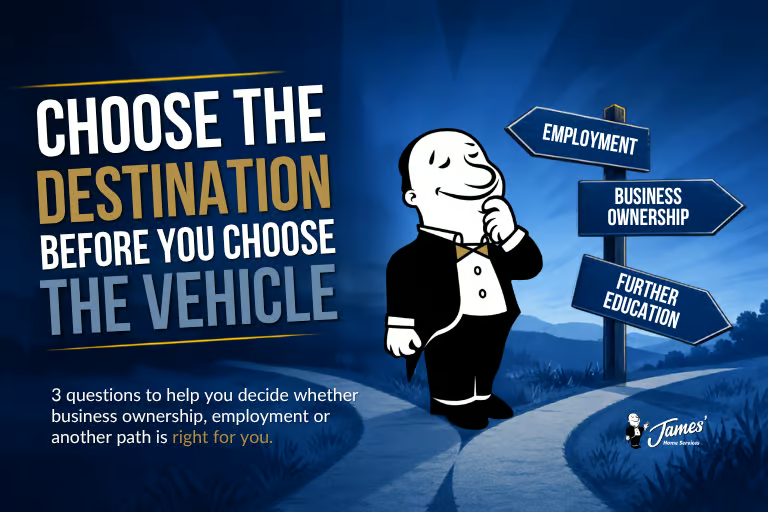
The problem is not always the option they chose. Sometimes the problem is the order in which they made the decision. Before choosing the vehicle, they needed to choose the destination.
A change can move you away from something without moving you towards the life you want.
Why the Next Step Feels So Difficult
Major decisions feel overwhelming because they rarely involve one simple question. A person considering business ownership may also be thinking about income, family time, identity, security, health, career progression and the fear of getting it wrong.
Someone leaving Defence may be adjusting to a different kind of structure and responsibility. Someone leaving FIFO work may want more time at home but still need an income that supports the household. Someone facing redundancy may feel pressure to replace their income quickly, even though the moment could also be an opportunity to rethink what they want from work.
These are not simply career decisions. They are life-design decisions.
That does not mean you need a perfect 20-year plan before taking your next step. Very few people have one. It means you need enough clarity to recognise whether an option is taking you in approximately the right direction.
Instead of asking, “Can I predict my whole future?”, ask, “What do I want a good life to look like, and is this choice capable of supporting it?” That is a much more useful place to start.
The Big Idea: Reverse the Decision
Most people begin with an option. Should I take this job? Should I do this course? Should I buy this business? Should I start working for myself?
A stronger decision starts one step earlier: what do I want my work to make possible?
That might include being available for school drop-off or family commitments, having greater control over your week, building an asset or long-term wealth, developing a particular skill or reducing financial uncertainty. It may mean wanting a predictable routine, greater responsibility, more independence, a stronger sense of team or room to grow beyond a fixed salary.
None of these priorities is automatically better than another. Predictability is not a lack of ambition. Independence is not automatically freedom. Employment is not failure, and business ownership is not success by default. The value of an option depends on whether it fits the person choosing it.
Good decisions do not lead everyone to the same conclusion. They lead people to the right conclusion for them.
That idea matters because business conversations are often distorted by ideology. Some people treat entrepreneurship as the answer to everything, while others see employment as the only responsible option. Advice is often based on the adviser’s personality, experience or financial position rather than the needs of the person making the decision.
A friend who loves routine may warn you against self-employment. A business owner enjoying a strong year may tell you to leave your job immediately. Someone who saw one business fail may decide that business ownership is reckless, while someone who saw one person succeed may assume it is easy.
These stories may be true, but they are not necessarily useful comparisons. You need to compare realistic versions of each path against your own priorities.
Question One: Where Do You Want to Go?
“Where do you want to be in ten years?” is a difficult question for many people. It can feel too big, too abstract or too permanent.
A better way to approach it is to remove the pressure of formal goal-setting and ask: What would a good life look like for me in five or ten years?
You do not need to know the exact job title, income or address. Start with the shape of the life. What time do you want to have available? Who do you want to be present for? How much financial responsibility do you expect to carry? Do you want to build something you own, or do you want to finish work and leave responsibility behind at the end of the day?
Consider whether you want clear structure or the opportunity to create your own. Think about whether you want to deepen an existing skill, learn a new one or lead other people. These questions help reveal what kind of vehicle may suit you.
A person who values predictable hours, a stable salary and a clearly defined role may be well suited to employment. That is not a lesser outcome. It may be exactly what their family and circumstances require.
Another person may find a fixed schedule deeply restrictive. They may want greater control over when they work, how they grow and what they build over time. Business ownership may deserve further investigation.
The key phrase is further investigation. Recognising that business ownership may fit your goals is not the same as deciding to start a business tomorrow. It is an indicator, not a conclusion.
The Difference Between Escaping and Choosing
One of the most dangerous reasons to start a business is, “I hate my boss.”
That feeling may be the trigger that makes you reconsider your future, but it is not enough to support a major investment of time, money and energy. Leaving a difficult situation can feel so urgent that any alternative looks better.
This creates a contrast problem. You are not judging the new option on its own merits. You are judging it against something you currently dislike.
A business may appear flexible compared with a rigid job, but flexibility in business does not necessarily mean fewer hours. It may mean you can choose when some of those hours happen.
Particularly during the start-up stage, business owners may be responsible for customer enquiries, quoting, service delivery, administration, bookkeeping, marketing and problem-solving. The owner has more control, but also carries more responsibility.
The decision becomes clearer when you stop asking whether business ownership looks better than your current job and start asking whether its full reality fits your preferred way of working.
Do not confuse wanting to leave your job with wanting to own a business.
Those are two different decisions.
Question Two: What Are You Comparing?
People regularly compare the best version of one path with the worst version of another. They compare a successful business owner with a disengaged employee, or a secure executive role with a struggling start-up.
Neither comparison is useful. A fair decision looks at realistic benefits, costs and responsibilities on both sides.
Flexibility
Employment may involve fixed hours and the need to request leave. Business ownership may provide more control over the schedule, but business owners can also feel permanently on call, particularly early on.
The honest question is not, “Which option has flexibility?” It is, “What kind of flexibility do I want, and what am I prepared to exchange for it?”
Work-Life Balance
A business can be structured around school drop-offs, health appointments or family responsibilities. Justin describes business ownership giving him the ability to take his children to school after years of leaving home and returning in the dark.
That is meaningful, but business ownership does not automatically produce balance. It creates an opportunity to design it, usually after a period of hard work and deliberate system-building. You may control your schedule, but you still need to build a viable business within it.
Autonomy
Autonomy sounds attractive because it means making your own decisions. The less glamorous half is accepting responsibility for those decisions.
There is no manager to blame when the plan does not work. There may be no one setting priorities, checking progress or creating the structure. For some people, this is energising. For others, it is exhausting.
The useful question is not simply whether you want to be in control. It is whether you can create direction and act without someone else supplying the structure.
Structure
Employment generally places you inside someone else’s structure. Business requires you to create your own.
That structure includes systems, routines, customer processes, financial controls and ways of measuring performance. A person who dislikes being managed may still struggle in business if they also dislike planning, consistency and accountability.
Freedom without structure tends to become chaos.
Growth
Employment often provides a visible pathway, but the pathway may have a ceiling or require sacrifices you do not want to make. A promotion might bring more money but also require constant travel. A senior role may come with greater authority but less time with family.
Business ownership can provide broader growth potential, but that potential is not guaranteed. It depends on the owner’s decisions, market, model, capability and willingness to keep learning.
Uncapped potential is not the same as automatic growth. It simply means the ceiling is not set by an employer.
Financial Risk
Employment can make income easier to predict. A salary allows people to budget and understand what will arrive each pay cycle.
However, employment is not free from risk. Businesses restructure, roles are made redundant and industries change. Income is also capped by the terms of the role.
Business ownership usually involves greater short-term uncertainty. There may be start-up costs, uneven cash flow and a period before the business reliably supports the owner’s living expenses.
The question is not whether one path has risk and the other does not. Both contain risk. The question is which risks you understand, which ones you can reduce and which ones you are prepared to carry.
Beware the Barbecue Mafia
Many major business decisions are discussed informally with friends, family and colleagues. That can be valuable, but it can also create a lot of noise.
One person knows somebody “absolutely killing it” in business. Another knows somebody who lost money. Someone else insists a secure job is the only sensible choice.
This advice is often based on one example, incomplete information and the adviser’s own attitude towards risk. The conversation may be well intentioned, but it rarely compares like with like.
Before accepting someone’s advice, consider whether they understand the option you are exploring, your financial position and what you want your life to look like. Ask whether they are describing genuine evidence or repeating a story, whether they are comparing realistic outcomes and whether their appetite for risk resembles yours.
You do not need to ignore advice. You need to filter it. The loudest person at the barbecue does not automatically have the most relevant experience.
Question Three: Are You Prepared?
This is where the decision becomes personal.
Business ownership is regularly presented through its outcomes: flexibility, independence, income potential and control. Preparation is less visible.
You need to consider whether you are prepared to learn skills you do not currently have, do necessary work you may not enjoy and remain consistent when early progress is slower than expected. You also need to be ready to take responsibility for the result, even when circumstances are difficult.
Preparation includes more than motivation. Are you mentally and financially ready for the pressure of change? Are the important people in your life aware of what the transition may require?
Starting a business while already in a serious personal, financial or relationship crisis can amplify the pressure. That does not mean every part of life must be perfect. It means you should be honest about the load you are already carrying.
Business ownership is not a reliable way to escape discomfort. It introduces a new category of discomfort. That discomfort can be worthwhile, but only when it is attached to a destination that matters to you.
Preparation does not mean having every answer. It means understanding what the path requires and choosing it with your eyes open.
You do not need to know everything before starting. You do need to be ready to keep learning after you start.
“Not Yet” Is a Valid Business Decision
One of the strongest outcomes of a good decision process is permission to decide that the timing is not right.
People sometimes treat a no as failure, but it may be evidence of judgement. Perhaps business ownership fits your long-term goals, but your financial buffer is not yet strong enough. Perhaps you want more autonomy, but your family currently needs predictable income. Perhaps you have the right motivation but need to develop skills, improve your health or reduce existing commitments before taking on more responsibility.
That does not mean business ownership is wrong forever. It may mean it is wrong now.
A useful self-assessment can produce different answers at different stages of life. Employment may be right today and business ownership right in three years. Further education may be the next step that makes a stronger business possible later.
The purpose of the framework is not to push you through every question until you reach entrepreneurship. It is to help you exit the process at the point that gives you the clearest and safest answer.
A Simple Decision Framework
When considering a major transition, work through these three questions in order.
1. Where do I want to go?
Describe what a good life looks like in five or ten years. Think about time, family, income, ownership, responsibility, routine and growth.
Do not choose the opportunity yet. Clarify the destination.
2. What am I actually comparing?
Assess employment, further education and business ownership honestly. Compare realistic versions of each.
Consider flexibility, structure, autonomy, financial risk, work-life balance, responsibility and growth potential. Do not compare one person’s best case with another person’s worst case.
3. Am I prepared?
Consider your motivation, financial position, energy, relationships, support, skills and willingness to do the work.
Do not ask only whether you want the outcome. Ask whether you accept the process required to reach it.
If the answers suggest that business ownership may suit you, the next step is not an ABN, a logo or a social media page. The next step is research.
If You’re Considering Starting a Business
1. Write a one-page description of your preferred life
Avoid vague goals such as “more freedom”. Describe what freedom would look like in practice. What time would you start? What responsibilities would you have? What income would the household require? What would you want to be available for?
2. Separate the push from the pull
Write down what is pushing you away from your current situation and what is pulling you towards business ownership.
If the push list is strong and the pull list is vague, pause. You may need a different job, not necessarily a business.
3. Compare complete realities
Assess income, hours, control, risk, responsibility, support and growth across each option. Include the difficult parts, not just the attractive ones.
4. Test your appetite for responsibility
Ask how you currently respond when plans fail, priorities are unclear or motivation drops.
Business ownership gives you decision-making authority, but it also removes many excuses.
5. Review your readiness with the people affected
Talk honestly with your partner or family about time, money, uncertainty and responsibilities.
A business decision made by one person can change life for the whole household.
6. Identify the support you would need
Do you need coaching, systems, peer support, technical help, marketing guidance or financial advice?
Needing support is not evidence that you are unsuited to business. Pretending you do not need it may be.
7. Treat your first conclusion as an indicator
Do more research before committing. Speak with business owners, ask uncomfortable questions and investigate the model, numbers and lifestyle.
Pay attention to vague answers or pressure to move quickly. A good opportunity can withstand careful examination.
Frequently Asked Questions
How do I know if starting a business is right for me?
Start by identifying what you want your work to make possible. Business ownership may suit you if you value autonomy, growth and control, and you are prepared to accept uncertainty and responsibility. It may not suit you if you strongly prefer predictable income, externally created structure and being able to leave work behind at a fixed time.
Should I quit my job because I am unhappy?
Not immediately. Unhappiness can be a useful signal, but it does not tell you what the correct alternative is. Separate the reasons you want to leave from the reasons you want to own a business. You may need a new employer, role, industry or qualification rather than self-employment.
Is owning a business better than having a job?
Neither is universally better. Employment and business ownership offer different combinations of security, control, responsibility, flexibility and growth. The better option is the one that suits your goals, circumstances and preferred way of working.
Am I ready to start a small business?
Readiness includes more than enthusiasm. Consider your financial position, motivation, health, family support, willingness to learn and ability to keep working through uncertainty. You do not need every skill on day one, but you need the commitment to build them.
Does business ownership give you more work-life balance?
It can give you greater control over when you work, but it does not automatically reduce your workload. During the start-up stage, owners may work longer or less predictable hours. Better balance usually comes from building strong systems and deliberately structuring the business.
Is a job really less risky than running a business?
A job generally provides more predictable short-term income, but it is not risk-free. Roles can be restructured or made redundant, and income may be capped. Business ownership usually carries greater uncertainty but can provide more control and growth potential. The risks are different rather than absent.
What is the biggest mistake people make before starting a business?
One of the biggest mistakes is choosing a business as a quick escape from an unhappy job. That can lead people to rush into branding, registration or spending before they have assessed whether business ownership fits their goals and readiness.
What should I discuss with my partner before starting a business?
Discuss expected income, savings, working hours, household responsibilities, risk, stress, decision-making and how long you are prepared to build before reviewing progress. Be specific about how the transition may affect both people.
What if business ownership sounds right, but I am not ready?
“Not yet” is a valid conclusion. Use the gap between interest and readiness to strengthen your finances, learn skills, research business models and improve your support network. A delayed decision can be far better than a rushed one.
What should I do after deciding business ownership may suit me?
Research the different ways to enter business ownership. These may include building from scratch, buying an existing business or choosing a supported model. Compare the costs, systems, risks, responsibilities and support attached to each option before committing.
Final Reflection
There is enormous pressure to make life-changing decisions look decisive. We admire people who move quickly, take the leap and back themselves, but speed is not the same as courage.
Sometimes courage is staying with the questions long enough to discover that the obvious next step is not the right one. Sometimes it is admitting that a secure role suits your family better right now. Sometimes it is recognising that the thing you have been calling a career problem is actually a lack of clarity about the life you want.
And sometimes it is accepting that business ownership deserves serious investigation, not because you are desperate to escape, but because it may genuinely be the right vehicle for where you want to go.
Choose the destination before you choose the vehicle. Then take the next right step, not simply the fastest one.
Explore The Real Franchise and learn from real conversations with people building businesses through James Home Services.
More Information on subscribing to your own business
Want to speak to a real person about joining our network? Get in touch directly with our National Director of Sales; Justin Kelly on 0438 780 363
Want us to contact you? Submit an enquiry