
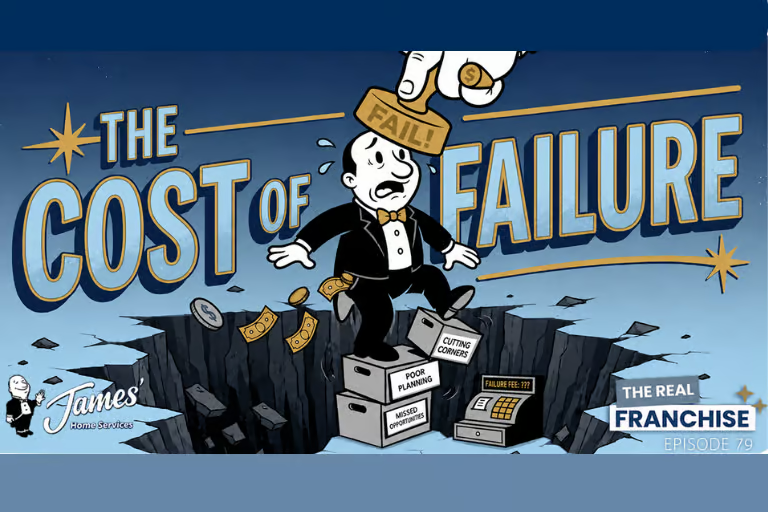
Start a business in Australia today and, on the real numbers, there is roughly an 80% chance it will not survive three years. So why do we only ever budget for the start-up?
Ask most people what it costs to start a business and you will get an answer almost straight away. Equipment. A bit of marketing. Some accounting advice to set up the structure. Maybe a car sign-writing job and a run of brochures. People have usually done the sums on getting going.
Ask the same person what it costs when the business does not work, and you tend to get a blank look.
That is the gap this article is about. The cost of business failure is the side of the equation almost nobody runs the numbers on, and yet it is the number that matters most. We are a culture that celebrates the launch. The idea, the leap, the decision to back yourself. We spend far less time on what the landing looks like for most people, and the landing is where the real story sits.
We glorify the launch. We almost never talk about the landing.
The Statistic That Gets Quietly Buried
The official figures are sobering on their own. Australian Bureau of Statistics data points to around 60% of businesses failing within their first five years. That alone should give anyone pause. But it gets more confronting when you look at how that data is actually collected.
The ABS treats a business as failed when it becomes insolvent, deregisters its ABN or business name, or stops lodging a BAS for five quarters. Here is the catch. You only lodge a BAS if you are registered for GST, and you only need to register for GST once you are turning over more than $75,000 a year. So the roughly 638,000 Australian businesses turning over under $50,000 never really show up in that picture. When they stop trading, they die quietly. The data does not see them, even though they were every bit as real as any other business.
Fold those quiet failures back in, and the figure people inside the industry recognise is closer to 80% within the first three years.
Turn that around and it lands even harder. If you start a business today, on those numbers you have about a 20% chance of still trading in three years. The trouble is that the human mind is wired to dismiss the negative. Tell someone eight in ten businesses fail and a large part of the room quietly thinks, “that won’t be me.” Everyone backs themselves to be the exception. Most of us, statistically, are not.
What Failure Actually Costs
So what does landing in that 80% actually cost? Take a cleaning business as a worked example, kept deliberately high level.
Call it around $10,000 just to get the wheels moving. Equipment, initial insurance, a company structure and a little accounting advice, some brochures, maybe getting the car sign-written. Then over the first twelve months, add roughly $30,000 for the ongoing side of things: running ads or paying an agency to run them, buying leads at $40 to $50 a pop, a website and the help to manage it, some SEO, a brand that looks professional, replacement equipment, products and chemicals. That is a conservative figure, not a generous one.
That puts you at $40,000, and it is still only half the story. The part nobody talks about is the income you gave up to chase this. If you walked away from a job paying around $60,000 to have a proper go, that wage is a real cost of the decision. Add it in and you are at roughly $100,000 over the first year.
And that number is still conservative. It does not include the $20,000 or so it takes to run a vehicle for a year, or the phone, or the internet, or the dozen other expenses that used to disappear quietly into your household budget and now have to be carried by a business that is not yet making money.
The cost of getting it wrong is almost always bigger than the cost of the help.
The dollars are only part of it. Money stress is one of the biggest drivers of relationship breakdown in this country, and the first twelve months of a struggling business can put enormous pressure on a household. The $100,000 is the part you can put on a spreadsheet. The strain on a family does not fit as neatly into a cell, and it is often the cost people remember longest.
Why We Think We Will Be the Exception
If the risk is that high, why do so many people walk into it without a second thought? A few reasons come up again and again.
The first is that we confuse being good at the task with being able to run the business. A brilliant cleaner, a skilled mechanic, an experienced tradesperson looks at their skill and sees a business. The skill is real. But running a business is not the task. It is everything around the task, and most of that is invisible until you are already inside it.
The second is cultural. “She’ll be right, mate. I’ve got this. How hard can it be?” is practically a national reflex. Add a social media feed full of highlight reels and the whole thing starts to look easy. What you do not see in those feeds is the decade of near-misses and insolvencies sitting behind most success stories. Even the serial entrepreneurs we admire have usually landed in the 80% more than once before anything stuck. We just never see that part.
There is a simple analogy for this. One of our co-hosts, Justin, has been driving for around 40 years and has never once broken down. Statistically reassuring, until you notice why. He has had the car serviced religiously, every 10,000 kilometres, for four decades. The reliability is not luck. It is maintenance he chose to pay for. Business is no different. The people who look like they are just naturally making it are, more often than not, the ones who quietly got help.
The Maths That Changes the Question
Most people frame support as another cost stacked on top of an already stretched budget. “I am spending 30 grand a year already. How could I possibly afford support as well?”
Turn it the other way up. If getting it wrong can cost you north of $100,000, a year of structured support costs a little over a tenth of that.
In our network, the first year works out to roughly $12,000 to $13,000. But you have not handed over $20,000 to $40,000 upfront to buy the business first, the way you would with many franchise models. You pay $1,000 to start, then $125 a week. The network covers around 90% of the start-up costs, provides the equipment, the marketing, the website, the business name registration, the call centre and the email handling, and you pay it back in small increments as you build. Around half of that $12,000 to $13,000 figure is simply repaying those start-up costs over time.
That is one model. It is not the only one. You can engage an independent business coach, or find a reputable startup program. The specific option matters less than the comparison behind it. Set against a possible six-figure loss, support stops looking like an expense and starts looking like insurance.
The question most people ask is “can I afford support?” The better question is “can I afford to fail?”
There is one more reason people go without help, and it has nothing to do with money. Asking for support can feel like admitting you are not up to it. We have made going solo so heroic that reaching out for a hand carries a quiet sense of shame. That is cultural conditioning, not sound judgement. In every other high-stakes decision we make, from our health to our cars to our tax, getting help is the smart, practical move. Starting a business is the one place we have somehow decided it is a weakness.
Not getting support is not the cheaper option. It is the expensive one.
Practical Takeaways: If You Are Considering Starting a Business
- Budget for the landing, not just the launch. Before you calculate what it costs to start, calculate what it costs if it does not work. Lost savings, lost income, the time and the personal toll. Support looks very different when it is sitting next to that number.
- Separate task skill from business skill. Being excellent at your trade is the starting point, not the whole picture. Map out what you actually know about marketing, cash flow, systems, pricing and compliance. The gaps are where the risk lives.
- Put a real number on the income you are giving up. The wage you walk away from is a genuine cost of the decision, even though it never shows up on an invoice. Include it honestly.
- Treat support as insurance, not overhead. Compare the cost of help against the cost of failure, not against zero. One is a known, modest figure. The other is a six-figure gamble.
- Notice if asking for help feels shameful. If it does, that feeling is conditioning, not good judgement. Normalising support is one of the most useful mindset shifts a new business owner can make.
- Do your homework on any support option. Look for street cred and volume. A program that has helped a lot of people start businesses has learned a lot of lessons, including from the ones that did not work.
- Ask how the money works. How does the fee structure operate? Who benefits when you do well? What happens to their income if you struggle? Good answers come without hesitation. Evasive ones tell you plenty.
Frequently Asked Questions
Why do so many small businesses fail in Australia? The common threads are undercapitalisation, poor cash flow, a lack of business systems, and the gap between being good at a task and being able to run a business around it. Many people start because they are skilled at the work, without accounting for everything else the business demands.
Is the 80% failure rate real, or just the official ABS number? The official ABS-style figure is around 60% within five years. That number excludes very small businesses that never register for GST, because they fall outside the data the ABS uses to track failures. Once those quiet failures are counted, the figure people in the industry recognise sits closer to 80% within three years.
How much does it actually cost to start a business in Australia? More than most people expect once you count everything. A modest service business can involve around $10,000 in setup and $30,000 in first-year running costs, before you even factor in the income you gave up to do it.
Is $100,000 a realistic figure for the cost of failure? For a lot of people, yes, and it can be conservative. Roughly $10,000 to start, $30,000 in first-year expenses and around $60,000 in lost wages adds up to about $100,000, and that still leaves out vehicle running costs, phone, internet and other expenses your household used to absorb.
Why don’t more people get help when they start a business? Three reasons come up most. They think they do not need it, they think they cannot afford it, or they feel a sense of shame about asking. The first two are usually wrong once you run the numbers. The third is cultural conditioning rather than good judgement.
Is business coaching or franchise support actually worth the money? For most new business owners, the comparison is what counts. If a year of structured support costs a little over a tenth of what failure would cost, the value is less about the advice itself and more about avoiding the expensive mistakes that are invisible until you are already making them.
Can you start a business on your own and still succeed? Absolutely. Plenty of people do. It is simply harder, and the margin for error is much smaller. The data suggests structured support meaningfully improves the odds, which is worth knowing before you decide which way to go.
What should I ask a franchise network before I sign up? Ask how the fee structure works and who benefits when you succeed. Ask how often you will actually hear from them, and who your coaches are and what they have built themselves. Ask to speak openly with current and former owners. A good network answers all of it without flinching.
Final Reflection
None of this is meant to frighten anyone out of starting a business. Plenty of people build something they are proud of, and the country needs more of them, not fewer.
The point is simpler than that. We send people into one of the biggest financial decisions of their lives with a story that says they should be able to handle it alone, and then we act surprised when so many of them do not make it. The cost of business failure is real, it is large, and it is almost entirely absent from the conversation we have with people before they begin.
Getting help is not weakness. It is the same practical thinking that makes you service the car, call the plumber and lodge your tax with an accountant. We have normalised it everywhere except the one place it might matter most.
This conversation comes from Episode 79 of The Real Franchise. Explore the full series for more honest, no-hype conversations with real people building businesses through James Home Services.
More Information on subscribing to your own business
Want to speak to a real person about joining our network? Get in touch directly with our National Director of Sales; Justin Kelly on 0438 780 363
Want us to contact you? Submit an enquiry