
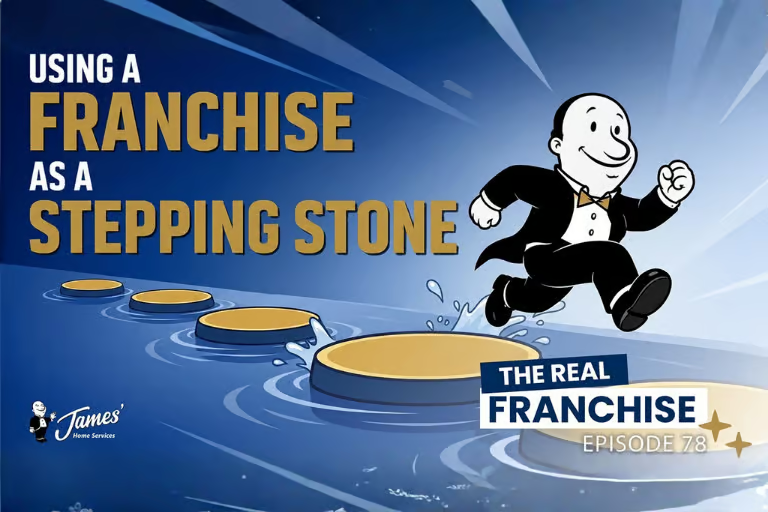
What the property ladder can teach us about starting small, learning fast, and getting out of business ownership with more than you went in with.
Nobody buys their dream home first.
Most of us start with the modest three bedder in the rural town, or the tiny miner’s cottage with one bathroom and a renovation list as long as your arm. It is not the house we imagined. It is the house we could afford, and the house we could learn on.
So why do we expect business ownership to work any differently?
Ask most people what is stopping them from starting a business, and two answers come up constantly. They cannot afford the business they actually want to run. And they do not know what they do not know yet. Both are real. Both are reasonable. And both are the exact reasons a surprising number of people never start at all, waiting instead for the capital, the confidence, or the certainty that the “real” business is the right one to begin with.
There is another way to think about it. One that treats the first business the way most of us already treat the first house: not as the destination, but as the first rung.
The Property Ladder, Applied to Business
In the property market, the path is familiar. You buy what you can afford. You learn the things you assumed you would never understand, plumbing, renovation, what a load bearing wall actually is. You build some equity, you sell, and you move to something better. Repeat that a few times and most people end up somewhere they would never have qualified for, or had the confidence for, on their first purchase.
Nobody looks at that journey and calls the first house a failure because it was not the forever home. It was never meant to be.
Business ownership can follow the same logic, but very few people talk about it that way. Most franchise networks talk about their businesses as a destination: sign here, and this is what you will be doing for the next five, ten, or twenty years. That framing is not dishonest, but it is incomplete. And it quietly discourages a lot of capable people who could thrive in business ownership, but who do not want to commit to one particular trade or service forever.
“You don’t have to start where you want to end. And if you start where you want to end, it’s the best way to ruin the ending and never get there at all.”
That is the shift worth sitting with. The first business does not need to be the dream business. It needs to be the one that teaches you how to run a business, at a cost low enough that the lessons do not bankrupt you while you are learning them.
The Two Fears That Stop Most People
Talk to enough people who are circling the idea of starting a business but have not taken the leap, and the same two fears surface again and again.
The first is financial. The business they picture, the one with staff, systems and someone else doing the day to day work, is not the business they can currently afford to build. So the gap between where they are and where they want to be feels too wide to cross.
The second is a knowledge gap, and it is the harder one to name. It sounds less like “I can’t afford it” and more like “I don’t know what I don’t know.” Marketing, pricing, compliance, cash flow, client acquisition, systems. Nobody arrives in business ownership already fluent in all of it, but not knowing the shape of what you are missing is enough to keep a lot of people standing at the edge.
Both fears point to the same solution: a lower stakes entry point, with a safety net underneath it, where the mistakes you inevitably make cost you a wasted hour rather than a wasted fortune.
“There’s the ‘I can’t afford a business like that,’ and there’s also the knowledge gap. I’ve never had a business. I don’t know what I don’t know.”
Why a Franchise Term Is Not a Life Sentence
One of the biggest misconceptions about franchising is the idea that signing the agreement locks you in for the full term, whatever that happens to be. In Australia, home services franchise terms commonly run anywhere from five years to twenty or thirty, depending on the network.
People treat that number the way they would treat a thirty year mortgage, as something they are stuck inside until it runs its course. Almost nobody actually lives out a thirty year mortgage. They pay it down, build equity, sell, and move on, often well before the term is anywhere near up.
A business with genuine profitability works the same way. If it is making money, it has value, and there will be a buyer for it. The more profitable the business, the more it is worth. That is true whether the business is five months old or fifteen years old. The franchise term sets a ceiling, not a sentence.
What is rare is a franchise network that says this openly. Most do not talk about exit strategies at all, let alone encourage business owners to think about their first franchise as a stepping stone rather than a forever commitment. That silence is not because the idea does not work. It is because very few networks build their systems and coaching around the assumption that people will eventually move on, taking what they learned with them.
Skills Compound the Same Way Equity Does
The financial upside of starting small is fairly intuitive. Lower entry cost, lower risk, the ability to sell later if the business has built value. The skills upside gets talked about far less, and it might matter more.
Every renovation on a starter home teaches you something that makes the next renovation easier and faster. The same is true of business ownership. Quoting, customer service, scheduling, handling a difficult job, managing cash flow through a slow month, none of that knowledge disappears once you sell the business. It becomes the foundation the next business gets built on.
“The skills you learn, the disciplines you learn, will save you and make it much easier for you to succeed in your next business.”
This is also where a structured network earns its keep. A good coaching system is not just there to help the business survive its first year. It is there to deliberately build the underlying capabilities, the eight or so fundamentals of running any service business well, so that whatever comes next, the next business, the next industry, the next bigger idea, has a stronger foundation under it.
There is a pattern worth noticing among people who go on to build large businesses and lose them. It is not unusual to hear about someone who built significant wealth, then lost it, then rebuilt again. Quite often, what separates the version that lasts from the version that does not is whether the foundational business disciplines, the unglamorous, simple things, were ever properly put in place. Skipping straight to the big dream business, without first building those habits somewhere low stakes, is one of the more common ways ambitious people come unstuck.
The Number Nobody Says Loudly Enough
Government data points to roughly 60% of Australian businesses failing within their first three years. Industry commentary widely puts the real figure closer to 80%, once you account for the very small, unregistered businesses that government statistics tend to exclude.
However you read the exact percentage, the pattern underneath it is consistent. Starting a business and making it work is harder than most people expect, and the culture around entrepreneurship, including a constant stream of social media highlight reels, does not prepare people for that reality.
Starting with a simpler, lower cost business is not a smaller ambition. It is a more deliberate one. It does not mean settling for less. It means choosing where the learning happens, in a business with an established, consistent demand and a high average hourly rate, rather than gambling that the dream business will somehow be the exception to the failure statistics.
It Does Not Matter If You Do Not Love the Service
A common reason people overlook a service based franchise, cleaning, lawn and garden care, or similar, is that they do not see themselves doing that work forever. They are not wrong. They likely will not be doing it forever, and that is fine.
What actually matters in a service business is not a passion for the specific task. It is a genuine ability to care about the people you are serving. No matter what business someone eventually wants to build, that skill, obsessing over the customer experience and delivering on what you promised, transfers directly. The specific service is almost incidental. The discipline of running a business well around real customers is not.
If You’re Considering Starting a Business
- Separate the dream business from the first business. They do not have to be the same thing, and treating them as separate decisions removes a lot of unnecessary pressure.
- Price your risk, not just your investment. Look for a model where a genuine mistake costs you time, not your savings or your home.
- Ask any network directly about exit strategy. How they answer, or whether they avoid the question, tells you a lot about how they think about your future.
- Look for businesses with consistent, established demand. A steady, simple service is easier to learn on than one with unpredictable demand or long sales cycles.
- Find out what skills the system is actually built to teach you. A good network should be coaching you in the fundamentals of business, not just teaching you to deliver one task.
- Talk to people who have already sold and moved on. Their experience tells you more about whether a network supports growth than any brochure will.
- Give yourself permission to start smaller than you imagined. It is not a compromise. It is how almost everyone who eventually builds something significant actually got there.
Frequently Asked Questions
Can I leave a franchise agreement before the full term is up?
In most cases, yes. A franchise agreement sets a maximum term, not a minimum stay. If the business has built genuine profitability, it has value, and it can typically be sold to another buyer well before the term ends, in the same way most people sell a house long before paying off a thirty year mortgage.
Is it true that most businesses fail in the first few years?
Government figures put the failure rate at around 60% within three years, and industry commentary suggests the real figure is closer to 80% once smaller, unregistered businesses are included. It is a hard environment to navigate without support, particularly for someone starting their first business.
Do I need to be passionate about the specific service a franchise offers?
Not necessarily. What matters far more is a genuine interest in looking after customers well. The specific service, whether it is cleaning, lawn care, or something else, is often less important than the underlying discipline of running a reliable, customer focused business.
What is the benefit of starting with a lower cost franchise rather than my ideal business?
A lower cost entry point reduces what a genuine mistake costs you while you are still learning. It also gives you the chance to build foundational business skills, quoting, scheduling, cash flow, customer service, before applying them to something bigger.
Can I really sell a small service franchise later on?
Yes, provided it has built profitability. Any business that makes money has a market of potential buyers, and the price generally tracks the level of profitability. Many business owners use this as a deliberate strategy, building a business with the specific intention of selling it once it reaches a certain value.
Why don’t more franchise networks talk about exit strategies?
It is uncommon, largely because most networks are built around the assumption that franchisees will stay for the full term. Few networks build their coaching and systems around the idea that an owner might use the business as a stepping stone, even though that is a realistic and common path.
What skills actually carry over from a first business to the next one?
The operational fundamentals, quoting accurately, managing cash flow, scheduling, handling customers, staying compliant, tend to transfer directly to whatever business comes next. These are the skills that are hardest to learn in theory and easiest to learn by actually running a business.
Final Reflection
There is a quiet kind of pressure that comes from believing your first business has to be the right one, forever. It is the same pressure that convinces people to overextend on their first house, or to skip the starter version of anything and go straight for the version they have not yet earned the experience to run well.
The honest version of business ownership looks more like the property ladder. Start where you can actually afford to learn. Make the mistakes that cost you an hour, not your savings. Build something with real value in it. And when you are ready, whether that is in two years or twenty, take what you learned and decide what comes next.
That is not a smaller version of ambition. It might be the version that actually gets you there.
Explore The Real Franchise and learn from real conversations with people building businesses through James Home Services.
More Information on subscribing to your own business
Want to speak to a real person about joining our network? Get in touch directly with our National Director of Sales; Justin Kelly on 0438 780 363
Want us to contact you? Submit an enquiry