
And the sooner we stop treating it like one, the fewer people will end up in the 80%.
You would never build your own house.
You probably don’t lodge your own tax return. You take your car to a mechanic when something sounds wrong. If you want to lose weight, you find a program. If you want to improve your sales skills, you find a course. On a busy Tuesday night you might even outsource dinner to UberEats.
We have completely normalised getting help. In almost every area of our lives, reaching out to someone with more skill, more experience, or a better system is considered sensible. Efficient. Smart.
Except when it comes to starting a business.
Ask most people whether they would start a business with structured support behind them, and a remarkable number will say they plan to figure it out themselves. To give it a crack. To work it out as they go.
That is the idea this article is here to challenge. Because starting a business is not a home project you can redo if it goes wrong. It is statistically one of the most significant financial decisions most Australians ever make. And the cultural habit of treating it like a DIY job is quietly contributing to one of the most underreported financial disasters in this country.
The Statistic Nobody Talks About Loudly Enough
Only 20% of businesses started in Australia are still trading three years later.
One in five. That means eight out of ten people who start a business will see it fail within three years. Not stumble. Not struggle temporarily. Fail.
For most of those people, the consequences are serious. Savings gone. Financial commitments unmet. Standard of living dropped. And a return, often humiliated, often exhausted, to the exact employment situation they were trying to leave. In worse cases, where people have put real capital into physical businesses, they lose their homes. They lose everything. And the financial recovery from that takes not months, but decades.
That 20% figure deserves a much louder conversation than it typically gets. We are a culture that glorifies the launch. The idea. The leap. We do not spend nearly enough time talking about what the landing actually looks like for most people.
Why We Confuse Doing the Task With Running the Business
The most common reason people believe they can start a business without significant support is that they are already good at something.
A brilliant plumber thinks: I know this trade inside out. I can build a business around it.
A skilled therapist thinks: I have years of experience. I can go out on my own.
A talented tradesperson, a capable professional, someone with decades of industry knowledge, they look at their skillset and see a business. And in a narrow sense, they are right. The skill is real. The experience is real.
What they are not accounting for is that running a business is not doing the task. Running a business is everything around the task. Marketing. Cash flow. Quoting. Scheduling. Staff. Compliance. Client acquisition. Retention. Pricing. Systems. Administration. Business development. Tax. Insurance.
There is a well-known book in business circles called The E-Myth by Michael Gerber. Its central argument is that the person who is best at the technical work is often the worst-prepared to run a business built around that work. Because being good at the task gives you confidence to start, but it does not give you any of the infrastructure you need to sustain it.
Business ownership is not one skill. It is a thousand skills arriving at the same time.
“There is absolutely no job in the world that prepares you for business ownership. Business ownership is everything, not just one or two skill sets.”
No matter how experienced you are, and no matter how many transferable skills you bring, business ownership will ask you for capabilities you have never needed to develop before. The question is not whether you will face that reality. The question is whether you will face it alone.
The 120 Things You Do Not Know You Do Not Know
Here is a number that puts the challenge in concrete terms.
When a new business owner joins the James Home Services network, the team completes over 120 individual tasks before that person’s business launches. Licensing. Systems. Compliance. Business coaching. Marketing setup. Lead generation. Process documentation. Brand onboarding. Financial structure. And more.
Those 120 things do not disappear if you go it alone. They still need to happen. You simply have to work out what they are first, and then figure out how to execute each one, and you have to do all of that while also trying to generate income and learn the business in real time.
Most people starting a business have no idea this list exists. That is not a criticism. It is simply what it means to be new to something. The knowledge gap is invisible until you are inside it.
“The older I get, the more I realise how little I actually know.”
That is not false modesty. That is what experience actually teaches you. The people who have been around business long enough understand that expertise is not a destination, it is an ongoing process of learning what you still do not know.
The Real Cost of Getting It Wrong
Justin, one of our franchise owners and co-host of The Real Franchise, tells a story that captures this well.
He is not a plumber. He knew this. But over several years, he attempted to fix three leaking taps in his home himself. Each one became a progressively worse problem. When he eventually sat down and calculated what each attempt had cost him by the time a real plumber came in to repair the damage, the average cost per tap washer came to $1,780.
The cost of calling a plumber from the start? Probably $150.
The gap between the cost of help and the cost of failure is almost always larger than people expect. That is as true for a leaking tap as it is for a business. The consequences of getting it wrong compound. They escalate. And by the time most people recognise the problem, the easy exits are already gone.
“The cost of getting it wrong can sometimes be way bigger than the cost of the solution in the first place.”
When the cost of proper support is compared against the cost of failure, including lost savings, lost income, the return to employment, and the emotional toll, support is not an expense. It is insurance against a loss that is far more expensive.
Why Franchising Gets Dismissed, And Why That Picture Is Incomplete
When most people hear the word franchise, a specific image forms. Large upfront fees. Royalty structures. A brand you have paid a premium for. And support that, in practice, amounts to a phone number you are told to ring if things go wrong.
That image is not entirely unfair. There is a version of franchising where the franchisor’s financial model is built entirely on what you pay in, rather than on whether you succeed. Where support is minimal. Where contact happens once or twice a year. Where business coaching, if it exists at all, is delivered by someone who has never actually built the business they are advising on.
But that version is not the only version. And conflating the two means a lot of people are writing off a category of support that, done properly, is exactly what they need.
At a recent industry event, a speaker proposed what the room treated as a bold new idea: franchise networks should be actively profit-coaching their business owners. It was presented as innovative. Forward-thinking. A concept the industry should consider moving toward.
James Home Services has been doing this for five years.
At the same event, it was suggested that networks should use the one or two annual touchpoints they have with franchisees to actually be useful, to review goals, discuss operations, support business performance.
James Home Services talks to its business owners one to two times per week, particularly through the critical early months when foundations are being laid and habits are being formed.
“I thought what we were doing was what everybody else was doing. The realisation I’ve had is that we are so far out in front, it’s not even funny.”
That gap matters. Not as a competitive claim, but as an explanation for why franchising has such a mixed reputation. If the standard model is that minimal, the scepticism makes sense. But it also means that when people dismiss all franchise networks based on what most of them look like, they may be walking away from the kind of structured support that could genuinely change their outcome.
The right questions to ask any network you are considering are not complicated. How does your fee structure work? Who benefits when I do well? How often will I hear from you? Who are your business coaches and what have they actually built? Can I speak to current and past franchisees openly?
Any good network should be able to answer every one of those questions clearly and without hesitation. If the answers feel evasive, or the transparency is not there, that is important information.
Practical Takeaways: If You Are Considering Starting a Business
- Audit what you actually know. Your industry skill is an asset, but it is not a business plan. Map out what you know about operations, marketing, cash flow, systems and compliance. The gaps are where the risk lives.
- Ask what it costs to get it wrong. Before you calculate the cost of support, calculate the cost of failure. Lost income, depleted savings, time lost, and the personal toll. Support looks different when it is sitting next to that number.
- Ask the hard questions of any network or program you consider. How do you make money? What happens to your income if I struggle? How often will we actually speak? Who coaches me and what have they built themselves?
- Look for transparency, not polish. A network with nothing to hide will show you everything. Current franchisees, their contact details, honest conversations about challenges. Gloss and brochures are not evidence of quality.
- Understand the difference between task skill and business skill. Being exceptional at your trade or profession is the starting point, not the whole picture. Business ownership needs both.
- Notice whether getting help feels shameful. If it does, that is cultural conditioning, not good judgement. Normalising support is one of the most important mindset shifts a new business owner can make.
- Find people who have walked the road. Advice from someone who has built, run, and sold a successful business in your industry is worth significantly more than advice from someone who has read about it.
Final Reflection
The conversation this article is drawn from does not end with a sales pitch. It ends with something more honest than that.
We have built a culture that sends people into one of the riskiest financial decisions of their lives and tells them they should be able to handle it without support. And because that message is so consistent, so familiar, and so loudly reinforced by the people around them, many people who genuinely want help feel ashamed to ask for it.
That is the thing worth fixing.
Not just for the sake of business outcomes, although those matter. But because the people on the other side of business failure, the ones who went back to the job they were trying to leave, the ones who spent years rebuilding, deserved a better conversation before they started.
Getting help when you start a business is not weakness. It is the same intelligent, practical thinking that runs through every other major decision most of us make. We just have not normalised it in this context yet.
That is what The Real Franchise is trying to change.
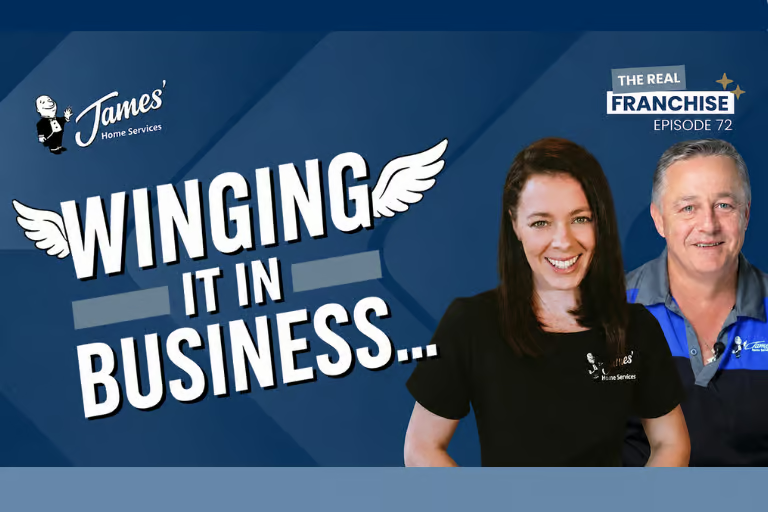
Listen to Episode 72 and explore the full series at The Real Franchise, real conversations with real people building businesses through James Home Services.
Frequently Asked Questions
Why do so many small businesses fail in Australia? The most common reasons are undercapitalisation, poor cash flow management, lack of business systems, and the gap between technical skill and business ownership capability. Many people start businesses because they are good at a task, without accounting for everything required to run a sustainable business around that task.
Should I start a business alone or get structured support? That depends on what you already know, what resources you have, and how much risk you can absorb. But the data suggests that structured support significantly improves outcomes. Going it alone is possible. It is just considerably harder, and the margin for error is much smaller.
Is a franchise worth the cost? It depends entirely on the franchise. The fee structure matters. A model where the franchisor only benefits when you benefit creates very different incentives from one where they are paid regardless of your performance. Ask clearly how the money works before you commit to anything.
What should I look for in a franchise network? Transparency, a fee model aligned with your success, genuine ongoing support rather than initial onboarding only, coaches who have built real businesses, and the ability to speak openly with anyone in the network.
What mistakes do first-time business owners most commonly make? Underestimating how many different things business ownership requires. Starting without systems. Not understanding their numbers. Taking on too much too fast. And not seeking help early enough because it feels like admitting they cannot do it.
Is business coaching worth the money? For most new business owners, yes. The value is not just the advice itself. It is having someone who has been through it helping you avoid the expensive mistakes that are invisible until you are already making them.
How do I know if a franchise network is legitimate? Ask to speak with current and past franchisees without a facilitator present. Ask about failure rates. Ask how the network makes its money. Ask what happens when someone in the network struggles. Good networks welcome those questions. Bad ones deflect them.
Is it normal to want help when starting a business? It is completely normal, and it is the sensible response to a genuinely complex challenge. The cultural narrative around self-reliance has made many people feel that asking for support is a weakness. It is not. It is the same practical thinking that makes you call a plumber instead of pulling out the spanners yourself.
What is the E-Myth and why does it matter for new business owners? The E-Myth by Michael Gerber argues that most small businesses are started by people who are technically skilled but unprepared for the reality of running a business. The “entrepreneurial myth” is that being good at the work automatically prepares you to build a business around it. It does not. The book is worth reading before you start.
What does business failure actually cost? Beyond the obvious financial losses, failure typically means depleted savings, an inability to meet financial commitments, a return to employment, and in many cases a permanent shift in how someone sees their own capacity for self-employment. For businesses involving significant upfront capital, it can mean losing a home. The emotional cost is real and long-lasting.
More Information on subscribing to your own business
Want to speak to a real person about joining our network? Get in touch directly with our National Director of Sales; Justin Kelly on 0438 780 363
Want us to contact you? Submit an enquiry