
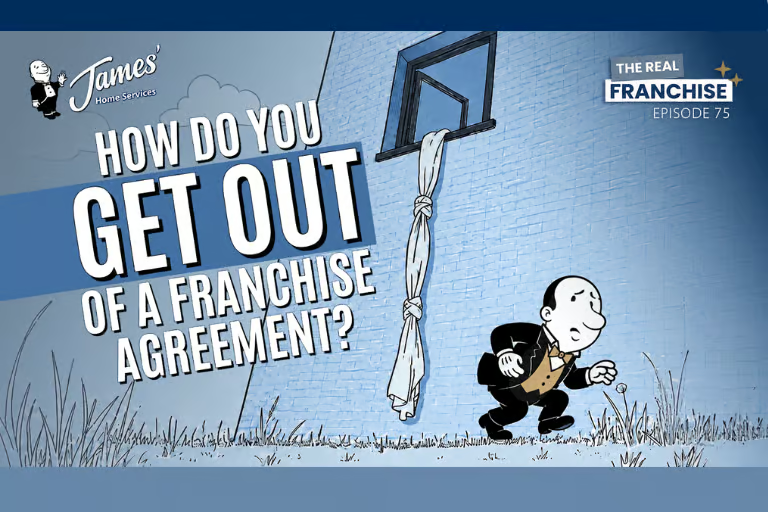
The three exit paths most people never realise they have, and why a little profit changes everything.
Ask most people what happens when you sign a franchise agreement, and you will hear some version of the same answer. You are locked in. For five years. For ten. For twenty or thirty with some networks. Signed, sealed, and stuck.
It is one of the most common beliefs in franchising, and it is one of the biggest reasons good people talk themselves out of an option that might have suited them well. The fear is not really about the business itself. It is about the trapdoor that seems to close the moment the pen leaves the paper.
Here is the part almost nobody says out loud. A franchise agreement is a contract, and contracts end. Some end on their term. Plenty end well before it. And if you have built even a modestly profitable business, getting out is usually far simpler than the person signing up ever imagined.
That is worth stating plainly, because very few franchise networks will talk about the exit at all. The whole conversation in this industry tends to be about getting in. This one is about getting out, and why understanding it before you start makes you a smarter business owner from day one.
Start With The End In Mind
There is a mindset shift that changes how you look at every business decision you will ever make, and it sounds almost backwards. Before you start, decide how you want to finish.
It is the kind of question a good business consultant asks and a lot of new owners have never considered. Someone sits down full of excitement about starting a business, and the first sensible question back is: how do you want to exit it? The usual response is surprise. Why would you think about leaving something you have not even begun?
Because at some point, you and your business will separate. That is not pessimism. It is simply how it goes. Life happens. You might want to retire, relocate, change direction, or step back for reasons entirely outside your control, such as a health diagnosis or a change at home. If you accept that separation is coming eventually, you start building differently from the very first week.
Any business you ever do in your life, from day one, you should have it in the back of your mind that at some point you are going to want to move on. So from day one, you should be building an asset.
A useful comparison is the family home. Almost everything you do to a house, you do with one eye on its value. You are not renovating the kitchen to wreck the place. You are thinking, does this add value, does this make it worth more, is the neighbourhood lifting the price. That is a completely normal way to think about a home. It should be just as normal a way to think about a business. Build something worth having, and you build something worth leaving on your own terms.
With that mindset in place, the exit stops being a trapdoor and becomes a plan. And in practical terms, there are three straightforward ways it happens.
Exit Path One: Sale
The most common and usually the cleanest way out of a franchise agreement is to sell the business. This is where planning from day one pays off, because to sell a business you need something worth buying. The good news is that the bar for that is a lot lower than most people assume.
A saleable business does not need to be turning over hundreds of thousands of dollars. It needs to be somewhat profitable and it needs a customer base. That is genuinely the core of it. There are buyers in the market at every stage. Some are looking for large, well-established, highly profitable operations. Others simply want the security of starting with a handful of customers and a bit of guaranteed weekly income already locked in, rather than beginning from a standing start at zero.
When a sale goes through, the franchise agreement transfers to the buyer. They step into your shoes and take on the obligations you held. Your responsibilities under the agreement come off your shoulders and become theirs. It genuinely becomes their business.
As long as you build a regular customer base and your business is profitable, you have something someone else wants to buy. That is the easiest and quickest way to get out of a franchise agreement.
This is also where transparency does a lot of quiet work. A business with clean, trackable records is far easier to sell than one with two sets of books and a fuzzy picture of what actually comes in. When every job is logged and the numbers are clear, a buyer can look at exactly what they are getting and make a confident decision. Branding, a website, an established reputation, and marketing systems all add to that saleable package, and in a good network those come as standard rather than something you have to build from scratch.
It is not a hypothetical either. Owners inside networks like James Home Services have bought a franchise, built it up, and sold it at the two to three year mark, all while sitting inside a five year agreement. The contract term did not trap them. The asset they built set them free, and in several cases made them money on the way out.
One caution belongs here, and it is the single most important thing to check before you sign anything. Make sure the agreement actually lets you build and sell equity in the business. In some networks it does not. There are franchisees who have sold up expecting to be paid for a business turning over thousands of dollars a week, only to discover the agreement allowed them to sell the stock on their shelves and nothing more. They recovered the value of their inventory and walked away from the value of the business itself.
Make sure you can generate wealth, because with many franchise agreements you simply can’t. Ask the question before you sign, not after.
Exit Path Two: Transfer
A transfer is a close cousin of a sale, with one key difference. In a transfer, the incoming owner does not really pay the outgoing owner, or pays only a small nominal amount. It sounds like a lesser option, but in the right situation it is the most valuable one of all.
Transfers come into their own when speed matters more than sale proceeds. The clearest example is a sudden health issue. When someone can no longer physically run their business, they often do not have the time to wait for the right buyer at the right price. What they need is for their customers to keep being looked after and for the obligation to lift quickly, so they can focus on what actually matters.
This is where the fee model of a network makes an enormous practical difference. Under a low-commitment subscription arrangement, there is no large upfront sum to claw back on the way out, so a transfer can happen almost immediately. In one real case, an owner facing a serious health situation had a friend step in and simply take over the subscription. From the first phone call to a new owner running the business was less than four weeks. The customers never lost service. The new owner got a running start with clients already on the books. He is still operating that business today.
It was completely seamless. From the first call to someone else taking on the business was less than four weeks, and the customers never skipped a beat.
The lesson underneath the story is the same one that runs through the whole conversation. A small base of regular customers is an asset even when the business is not yet highly profitable. It is enough to hand someone a genuine head start, which takes the fear out of jumping in for them, and takes the pressure off you when you need to move on in a hurry.
Exit Path Three: Mutual Termination
The third path is the one that sounds the most intimidating and is actually the most ordinary. A mutual termination is simply both parties agreeing to end the arrangement, or to vary its terms. Any contract can be changed at any time if everyone involved agrees to the change. That is not a loophole. It is how contracts work.
The easiest way to understand it is to think about renting a house, which most of us have done. You sign a tenancy agreement for twelve months. Eight months in, you finally pull your deposit together and buy your own home. Now you have four months left on a lease and a new house to move into. You have two ways out. You find another tenant to take over, or you come to an arrangement with the landlord over the balance of the term.
A franchise agreement works in a very similar way. Finding another tenant is the same idea as selling or transferring your business. Coming to an arrangement over the balance is the same idea as a mutual termination with the franchisor. Most of us have broken a lease at least once in our lives, often just because staying no longer suited us, and we did not treat it as a catastrophe. A mutual termination deserves the same calm.
A mutual termination sounds scary, but it is actually quite normal. It is no different to how a rental agreement on a house works, and most of us understand that.
Why The “Locked In Forever” Myth Persists
If exits are this manageable, why does almost everyone believe the opposite? Part of it is a simple confusion between the term of an agreement and a life sentence. People see a five, ten, or twenty year figure and assume it describes how long they are trapped, rather than the outer boundary of an arrangement they can leave through several doors well before then.
Part of it is silence. The franchising industry loves to talk about the launch and rarely talks about the departure. When nobody explains how you leave, fear fills the gap. And part of it, unfortunately, is earned. There genuinely are networks where the only thing you can sell is your inventory, where the fee model is built entirely on what you pay in rather than on whether you succeed. Those experiences are real, and they colour how everyone views the category.
The consequence of the myth is quietly expensive. Some people avoid franchising altogether and take on far more risk going it completely alone. Others sign up but stay stuck longer than they should because they do not realise they have options. And when life forces a change, they panic, because they believe they are chained to something they cannot escape.
The better alternative is not complicated. Choose a network whose agreement genuinely lets you build and sell equity, and then build profitability on purpose, because profitability is what turns every one of these exit paths from theory into reality. A business with even a little profit and a few loyal customers is a business you can sell, transfer, or wind down on reasonable terms. A business with none of that is far harder to leave, regardless of what the contract says.
Practical Takeaways: Before You Sign Anything
- Start with the end in mind. On day one, ask yourself how you eventually want to exit. Building an asset from the outset changes how you run the business every week.
- Check whether you can actually build and sell equity. Some agreements only let you sell stock or inventory, not the value of the business itself. Ask this directly before you commit.
- Read the exit clauses, not just the term length. Look for how sale, transfer, and mutual termination are handled. The term is the boundary, not the whole story.
- Build profitability early and deliberately. Even a small, regular customer base is a saleable asset. Profitability is what makes every exit path work.
- Keep clean, transparent books. One clear set of records makes a business far easier to sell and gives a buyer the confidence to take it on.
- Understand the fee model. A large upfront fee is harder to recover on exit. A low-commitment structure often makes a fast transfer far simpler when life demands it.
- Ask how people usually leave. A good network will happily explain the common exit routes and let you speak to someone who has actually been through one.
Frequently Asked Questions
Am I locked into a franchise agreement for the full term?
Not in the way most people assume. A franchise agreement is a contract with a term, but the term is the outer boundary, not a guarantee that you must stay the whole time. Depending on the agreement, you can generally exit through a sale, a transfer, or a mutual termination well before the term ends.
Can I sell my franchise before the term ends?
In most reasonable agreements, yes. When you sell, the agreement transfers to the buyer, who takes on the obligations you held. What you need is a saleable business, which usually means something that is at least somewhat profitable with an established customer base.
What is the difference between selling and transferring a franchise?
A sale is where a buyer pays you for the business you have built. A transfer is where someone takes over the business and agreement, usually for little or no payment. Transfers are especially useful when you need to exit quickly, such as a sudden health issue, and do not have time to wait for the right buyer.
Does my business have to be highly profitable to sell it?
No. There are buyers at every stage. Some want large, established operations, but many simply want the security of starting with a handful of existing customers and some guaranteed income rather than building from zero. Even a modestly profitable business with regular clients has value to the right buyer.
What happens to the franchise agreement when I sell or transfer?
It transfers to the incoming owner. They step into your position and assume the responsibilities and obligations you held under the agreement. Once that happens, the business, and the agreement, become theirs.
What if I need to exit quickly because of a health issue or emergency?
This is exactly the situation a transfer is designed for. Because a transfer does not require a buyer to find and pay a large sum, it can happen very fast, sometimes in a matter of weeks. Your customers keep being served, and the obligation lifts from you at a time when you need to focus on other things.
What is a mutual termination?
It is when both parties agree to end the agreement or vary its terms. Any contract can be changed if everyone involved agrees. A common comparison is breaking a lease on a rental property by coming to an arrangement with the landlord over the remaining term.
Why don’t more franchisors talk about how to leave?
Most of the industry focuses on getting people in rather than helping them get out. That silence tends to feed the fear that you are trapped once you sign. A network that is confident in its model should be willing to explain the exit routes openly.
What should I check about exits before I sign a franchise agreement?
Ask whether you can build and sell equity in the business or only its inventory, how sale and transfer are handled, what a mutual termination would involve, and whether you can speak to someone who has actually exited. Clear answers are a good sign. Evasive ones are important information.
Can a franchise be a way to build wealth?
It can be, but only if the agreement lets you build and keep the value of the business you create. Some owners deliberately grow a business inside a network specifically to sell it later. The key is confirming, before you sign, that the value you build is genuinely yours to sell.
Final Reflection
The reason to understand all of this before you start is not so you can plan your escape. It is so you can build with confidence. When you know you are not trapped, you make clearer decisions, you take a sensible amount of risk, and you build something worth having rather than something you feel chained to.
There is a bigger point underneath the three exit paths. The real work of a good network is not just helping people start a business. It is teaching them the skills to run a successful one, so those skills travel with them into whatever comes next in their life. And if that is the genuine goal, then the agreement itself has to allow people to move on when the time is right. An exit is not a failure of the relationship. It is the natural end of one chapter and the beginning of another.
So if the fear of being locked in has been quietly holding you back, it is worth replacing it with a better question. Not can I get out, but am I building something worth selling. Because if the answer to the second question is yes, the first one takes care of itself.
Listen to Episode 75 and explore the full series at The Real Franchise, real conversations with real people building businesses through James Home Services.
More Information on subscribing to your own business
Want to speak to a real person about joining our network? Get in touch directly with our National Director of Sales; Justin Kelly on 0438 780 363
Want us to contact you? Submit an enquiry